China Is Building an AI-Native Generation — and Aiming for Universal AI Literacy by 2030
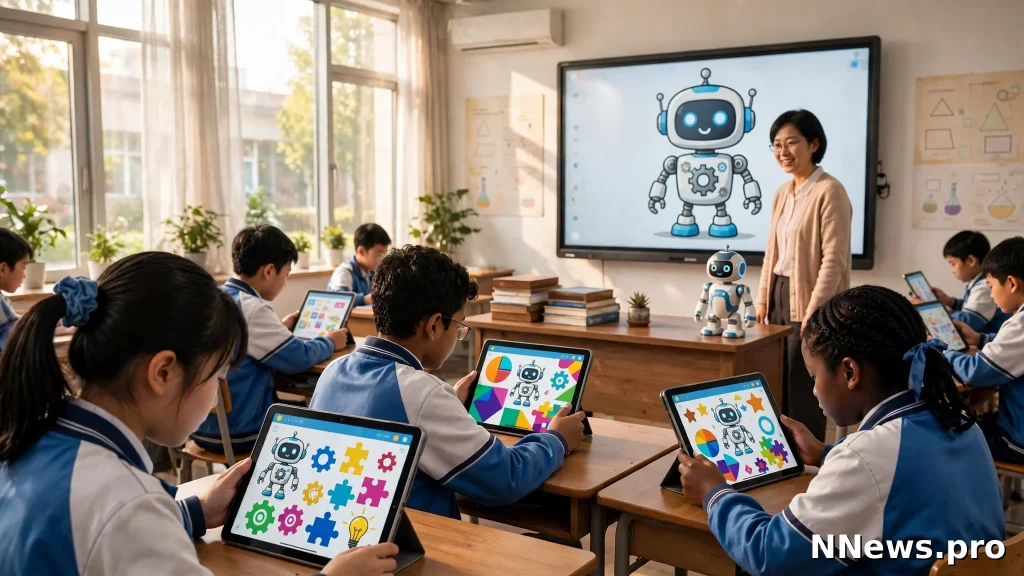
A 13-year-old student in Beijing has already built more than 200 apps with artificial intelligence, including a homework-submission platform and a secondhand marketplace. He wants to become a computer scientist. He is the sharp end of a national experiment: China is weaving AI into the education of nearly 200 million schoolchildren, with a stated goal of making AI literacy universal among them by 2030, according to a Reuters examination published on Monday, November 16.
The effort spans elite private schools and rural classrooms hundreds of miles apart, backed by binding provincial plans and billions in spending. But early research suggests the payoff is uncertain: students who lean on AI most may be learning less, not more.
A national plan with a 2030 deadline
The drive is anchored in a national “AI + Education” Action Plan issued in April 2026 by China’s Ministry of Education and four other departments, aiming for a comprehensive AI education system at every stage of schooling — and AI literacy for the wider public — by 2030. AI competence is also being folded into teacher qualification exams.
China’s education ministry has pushed schools to introduce AI courses, train teachers, and run pilots since 2024. President Xi Jinping has declared AI education fundamental to reform, and Beijing views the technology as central to its economic future and its technological rivalry with the United States.
A Reuters review of provincial blueprints found coordination unseen elsewhere: nearly half of China’s provinces and municipalities have binding plans. Shanghai requires at least 30 hours of teaching on AI skills per grade each year. The Beijing city government plans to set up 100 AI pilot demonstration schools and to integrate AI into student health monitoring. Regions including Ningxia and Gansu plan to build AI literacy into high-stakes school entrance exams by 2027. The applications reach well beyond coding lessons: Guizhou is integrating AI facial recognition and behavioral analysis into classrooms. Shanghai is deploying systems for mental and physical health monitoring. In Yunnan, 14,000 classrooms are slated to have lessons recorded and analyzed by AI. Chinese schools have effectively become a high-stakes testing ground for the opportunities and risks AI poses to education worldwide.
What it looks like inside the classrooms
At the Beijing New Talent Academy, a $39,000-a-year boarding school serving more than 2,000 students, the AI push is visible everywhere. Students program humanoid robots to play soccer, attend coding workshops, and train on flight simulators. Posters across the 30-acre campus encourage students to “create a virtual world in five minutes with AI vibe coding.”
Peng Gaodi, the 13-year-old app builder, said the technology has changed how he studies. “In the past, if I couldn’t solve a problem at home, I’d have to call my teacher, which increases their workload,” he told Reuters. “But now I can just ask AI to help me learn better. It noticeably improved my learning efficiency.” Headmaster Liu Wei said only a small minority will become AI scientists or engineers; for the rest, the aim is to make AI an everyday tool for learning and creating.
AI fills a teacher gap in rural China
Hundreds of miles away in rural Anhui province, the same technology is being used to solve a very different problem: a shortage of qualified teachers. At Funan County Qinqing High School, whose 4,000 pupils are mostly the children of migrant workers, core subjects are taught through AI-generated lessons. Students follow personalized classes on tablets, with AI agents posing questions rather than handing over answers when they struggle.
“An AI agent doesn’t suffer from fatigue, and it never makes a student feel stupid for asking a basic question,” headmaster Yang Tianliang told Reuters. The school uses Chinese AI models from Alibaba’s Qwen, ByteDance, and Z.AI to generate lessons, images, and videos. Yang credited the approach with helping lift university admission rates from below 60 percent to 90 percent in recent years, although Reuters said it could not independently verify those figures. He estimated that at least 200 other Chinese schools were experimenting with similar systems.
A Reuters review of more than 100 government procurement documents found authorities committed at least $31 million in the past year to AI classroom equipment, training, and teaching platforms — and the true figure is likely far higher, scattered across thousands of local budgets. Consultancy iResearch estimates 2025 spending on education digitalization at just under $83 billion, with generative AI projects accounting for 46 percent of AI education procurement.
The evidence is mixed
For all the scale and spending, China has yet to establish a standard framework for measuring AI literacy, leaving schools to experiment and success difficult to assess. “Mature, widely adopted assessment rubrics for compulsory school-level AI competency are still being built,” Selena Guo, portfolio lead at research firm China Policy, told Reuters.
A study of nearly 27,000 Chinese teenagers linked AI adoption to an 18 percent rise in homework scores but a 20 percent fall in monthly exam scores within six months, with the biggest drops in social science. Another nationwide survey of more than 320,000 pupils this year reported benefits from AI but also dependence and weaker independent thinking. Students who used AI at least three times a week showed lower memory, comprehension, analytical, and creative skills than less frequent users.
Related Articles


The findings do not establish causation, but they reinforce concerns about cognitive outsourcing — children delegating mental tasks to technology instead of developing those skills themselves. Ted Mo Chen, chief of staff at Chinese education technology startup ClassIn, warned that children’s thinking processes could be “completely bypassed” if schools failed to prevent them from relying on AI for quick answers. “Implementation is all over the place,” he said, adding that few schools he had visited had integrated AI into the curriculum effectively.
Some families are already setting their own guardrails. Peng said he tries to solve coding problems himself before asking AI for hints rather than complete answers. “I think AI is a tool that helps me, not something I depend on.” In Beijing, parent Rita Luan, whose 11-year-old daughter attends a leading public school, makes her daughter spend 15 minutes trying to solve a difficult math problem before turning to ByteDance’s Doubao chatbot, then solve the same problem again days later without help. “The point is to make sure she actually digested the solution,” she said.
How the United States compares
The contrast with the United States is stark. According to Stanford University’s 2026 AI Index, the US relies on decentralized, nonbinding guidance and lacks dedicated funding or state-level teacher standards for AI in schools. In the United States, teacher preparation programs struggle to teach AI as new teachers enter classrooms unprepared, according to a national survey of teacher educators published by Education Week on November 16 — most programs offer no stand-alone AI course, and about a third of faculty have received no AI training at all.
College students say they use AI to learn but think everyone else is cheating, according to a Dartmouth survey, and England’s regulator warned that AI has made university coursework close to impossible to grade. China is betting that a coordinated, top-down approach can capture the benefits while managing those risks.
Why this matters
China’s experiment matters for American readers for three reasons. First, it is a direct challenge in the race for the next generation of AI talent: teaching 200 million children to build with AI from an early age creates a workforce pipeline the United States does not yet match. Second, it is a live test of the biggest open question in education technology — whether AI in the classroom produces deeper learning or quieter dependence — and the early data points both ways. Third, the tools are the same ones American students already use every day, so the safeguards Chinese parents are improvising may soon be needed everywhere.
What to watch next
The next milestones come quickly. Ningxia and Gansu plan to fold AI literacy into entrance exams by 2027, which will show whether the subject is treated as a real academic requirement or a slogan. AI competence is already being added to teacher qualification exams, and a national framework for measuring AI literacy is still being built — its shape will determine whether schools are judged on genuine understanding or on how fluently students can prompt a chatbot. If larger studies confirm that heavy AI use weakens exam performance and independent thinking, the world’s biggest classroom experiment may have to change course.
Frequently Asked Questions
What is China’s goal for AI literacy in schools?
China aims for AI literacy to be universal among schoolchildren by 2030, under a national “AI + Education” Action Plan issued in April 2026 covering all stages of schooling, from primary school through university and lifelong learning.
How much AI teaching will Chinese students actually get?
It varies by province. Shanghai mandates at least 30 hours of teaching on AI skills per grade each year. Beijing is setting up 100 AI pilot demonstration schools. Nearly half of China’s provinces and municipalities have binding plans, but implementation differs widely from school to school.
Does using AI actually help students learn?
The evidence so far is mixed. A study of nearly 27,000 Chinese teenagers linked AI adoption to an 18 percent rise in homework scores but a 20 percent fall in monthly exam scores within six months. A survey of more than 320,000 pupils found benefits but also dependence and weaker independent thinking among the heaviest users. Neither study proves AI caused the changes.
How does the US approach to AI in schools differ?
The United States relies on decentralized, nonbinding guidance, with no dedicated federal funding for AI in schools and no state-level teacher standards, according to Stanford’s 2026 AI Index. China has a binding national plan, provincial mandates, and AI requirements in teacher certification.
China’s bet is that teaching 200 million children to build with AI will produce a generation of innovators. The exam results, the research, and the students themselves will show whether the world’s largest classroom experiment delivers on that promise — or teaches a harder lesson about outsourcing the thinking.
Sources: Reuters — “Inside China’s drive to build an AI-native generation” by Laurie Chen and Xiuyuan Ning, November 16, 2026; Georgetown University Center for Security and Emerging Technology — English translation of China’s “AI + Education” Action Plan; People’s Daily Online — “China launches AI empowering education action plan, includes AI into teacher qualification exams,” April 10, 2026; Stanford University 2026 AI Index.