SpaceX Catches Starship Upper Stage With Tower Arms in Historic First After 22-Hour Orbital Flight
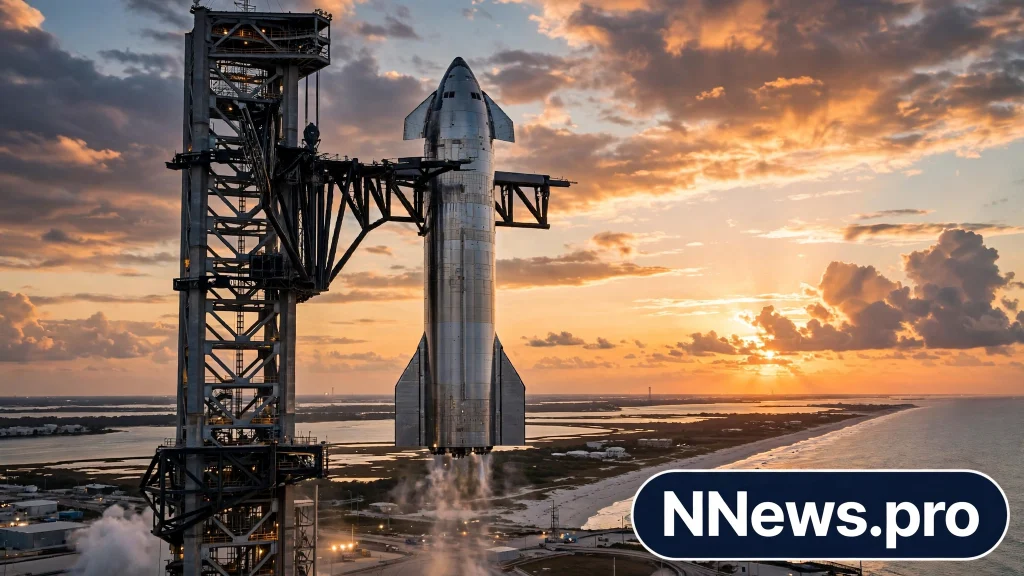
SpaceX caught the upper stage of its Starship rocket with the giant mechanical arms of its launch tower on Saturday, November 14, pulling off a first in spaceflight: no spacecraft returning from orbit had ever been caught by its launch tower before. The vehicle, known as Ship 42, settled into the arms at SpaceX’s Starbase facility in Texas about 22 and a half hours after lifting off, completing a mission that also delivered 26 next-generation Starlink satellites to orbit.
The catch capped the most ambitious Starship test flight yet, but the mission was only a partial success. The Super Heavy booster that launched Ship 42 failed to make its own planned return and was lost over the Gulf of Mexico on Friday, denying SpaceX the double catch it had attempted for the first time.
How the catch played out
Flight 15, the 15th full-scale Starship test, lifted off from Pad 2 at Starbase on Friday afternoon, November 13. Shortly after reaching orbit, Ship 42 released 26 Starlink V3 satellites, the latest version of SpaceX’s broadband spacecraft. The ship then stayed in space for more than 22 hours, circling Earth 14 times while flight controllers monitored its systems.
The return began with a roughly 10-second burn of a single Raptor engine to drop the spacecraft out of orbit. Ship 42 then plunged back through the atmosphere on its heat shield, shedding almost all of its orbital speed before swinging out over the Gulf of Mexico for its final approach. Three Raptor engines lit for a landing flip that brought the vehicle upright, and it slowed to a hover beside the launch tower as the two steel arms — nicknamed the “chopsticks” and part of the structure SpaceX calls Mechazilla — closed around it.
“Mechazilla has caught the Starship,” SpaceX commentator Dan Huot said on the company’s livestream as the arms took the vehicle’s weight. SpaceX’s own flight timeline put the landing burn and catch at about 22 hours and 32 minutes after liftoff, at roughly 4:30 p.m. ET on Saturday. Elon Musk later posted a video on X showing himself inspecting the recovered ship.
The booster that did not come back
The flight’s other half went wrong within minutes of launch. The Super Heavy booster was supposed to return to the same tower shortly after separating from Ship 42, but its engines stopped firing too early during the return, and its guidance system determined the vehicle was not correctly positioned for a catch. An automated abort diverted the booster offshore toward the Gulf of Mexico, where it exploded before reaching the water, according to CNBC. SpaceX’s Kate Tice described the sequence in comments reported by the Associated Press, and the company said it was still investigating the root cause.
SpaceX had caught Super Heavy boosters with the tower arms three times on earlier flights, most recently in March 2025. But the upper stage is a far harder vehicle to recover: it flies higher, farther and faster, and it must survive a fiery reentry from orbital speed before it can even attempt a landing. Flight 14 in September was the first time a Starship had reached orbit at all, and earlier ships ended their flights with ocean splashdowns.
Why this matters
Recovering the ship is the missing piece of SpaceX’s plan to make Starship fully and rapidly reusable. The company wants to fly the same vehicles again with minimal refurbishment, the way airliners are reused, and that only works if both halves of the rocket come home. A booster catch alone leaves the most expensive and complex part — the spacecraft itself — as a throwaway.
Related Articles


The milestone also matters beyond SpaceX. A version of Starship is NASA’s planned lander for returning astronauts to the Moon under the Artemis program, and the same vehicle is the backbone of SpaceX’s plan to expand its Starlink satellite network. The 26 V3 satellites deployed on this flight carry about 10 times the downlink capacity of a Falcon 9 Starlink launch, according to SpaceX’s third-quarter results. SpaceX President Gwynne Shotwell has said the company aims to refly a recovered second stage by early next year.
Latest developments
The catch came a day after SpaceX’s Starbase facility in Texas made other headlines this week, and it followed a busy stretch for the launch industry: ULA’s Vulcan rocket returned to flight carrying Amazon satellites, and Rocket Lab’s 100th Electron launch set a pace record for commercial rockets. But Flight 15 stands apart as a genuine first — the first time any company has brought an orbital spacecraft back to its launch site and caught it.
SpaceX has not yet said when Ship 42 might fly again, or when it will try another double catch. The booster investigation comes first, and the company will want to understand exactly why the engines shut down early before committing another vehicle to the tower. For now, the image of a spacecraft hanging in the arms of its own launch tower is the clearest sign yet that fully reusable heavy-lift rockets are moving from ambition to reality.
Frequently Asked Questions
What exactly did SpaceX catch on Saturday?
The upper stage of Starship, the spacecraft known as Ship 42. It is the part of the rocket that actually reaches orbit, deploys satellites and — in future missions — will carry crew and cargo. The Super Heavy booster, the rocket’s first stage, was lost on the same flight.
Why is catching the ship harder than catching the booster?
The booster separates within minutes of launch and comes straight back. The ship flies for hours at orbital speed, must survive reentry heating on its heat shield, and then has to arrive at the tower on a precise path after shedding nearly all of its velocity. Only then can the tower arms safely take its weight.
What happened to the Super Heavy booster?
Its engines stopped firing too early during the return, and its guidance system judged it was not correctly positioned for a tower catch. An automated abort diverted it toward the Gulf of Mexico, where it exploded before reaching the water, according to CNBC. SpaceX is still investigating the cause.
When could Starship fly again?
SpaceX has not announced a date for Flight 16. President Gwynne Shotwell has said the company aims to refly a recovered second stage by early next year, but that depends on the booster investigation and on inspections of the recovered Ship 42.
SpaceX proved on Saturday that a spacecraft can come home from orbit and land in the arms of its own launch tower. One catch does not yet make Starship a routinely reusable system — the booster failure on the same flight is a reminder of that — but it clears the hardest technical hurdle on the path to getting there.
Sources: CNBC; Associated Press; BBC News; AFP; SpaceX; Aerospace America.