More U.S. Colleges Report 1 in 10 Students With a Disability
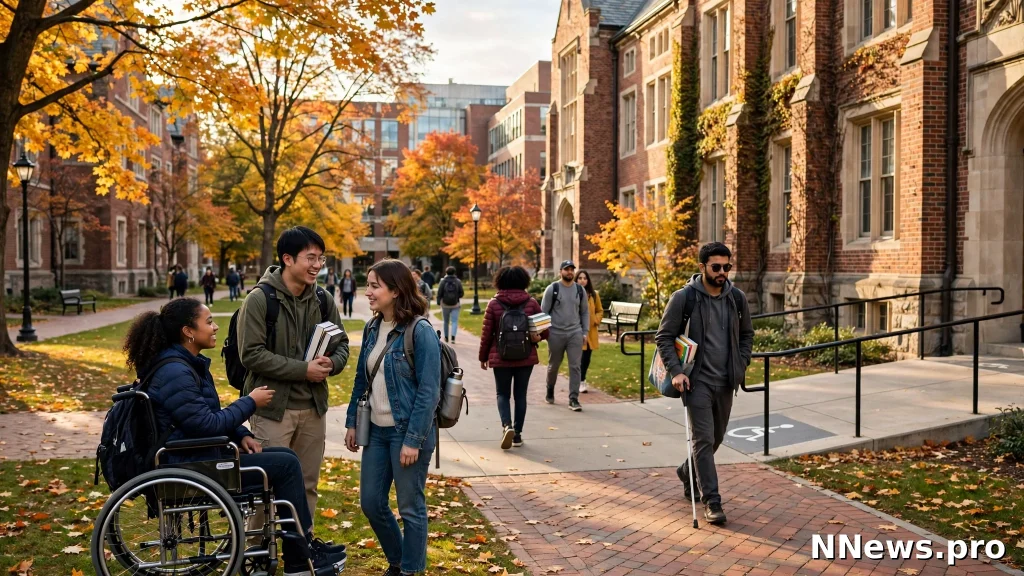
More than one in six American colleges now reports that at least one in 10 of its undergraduates is formally registered with a disability, according to a new analysis of federal data — a share that has grown sharply over the past 15 years and is reshaping classrooms, dormitories and disability offices across the country.
The Chronicle of Higher Education analyzed data from the Integrated Postsecondary Education Data System, known as IPEDS, covering more than 3,500 two- and four-year institutions. It found that in fall 2023, more than 17 percent of colleges had 10 percent or more of their undergraduates registered with campus disability offices, up from just 2 percent in 2008. Nearly half of all institutions — more than 46 percent — reported that at least 3 percent of their undergraduates were registered.
The trend has accelerated in recent years. In a separate Chronicle analysis, the number of colleges where at least one in 10 undergraduates reported a disability rose by 50 percent in five years, from 399 institutions in 2020-21 to 621 in 2024-25.
The numbers are highest at selective schools
The rise is most pronounced at the nation’s most selective colleges. Seven out of 10 colleges with admissions rates below 20 percent had more than 10 percent of their undergraduates reporting a disability, the Chronicle found.
Stanford University reports the highest share in the country, aside from schools designed specifically for students with disabilities: 38 percent of its roughly 7,800 undergraduates were registered with the university’s Office of Accessible Education in fall 2023, according to the Chronicle’s analysis of government data. That is far above the national median of 5.3 percent and the California median of 4 percent.
Other selective liberal arts colleges report similarly high figures. Pitzer College, Pomona College and Scripps College all report that more than 20 percent of their undergraduates are registered with campus disability offices. At the University of California, Berkeley, about 13 percent of students were registered in the latest survey, and the number of students receiving accommodations there rose 44 percent between 2020 and 2025.
A New York Times analysis of the same federal data, published in March, found that the number of college students reporting disabilities rose by more than 50 percent over the past decade. At Harvard, Cornell and the University of Chicago, 21 percent of students were registered as having disabilities in 2024. A decade earlier, Harvard and the University of Chicago reported less than 3 percent, and Cornell reported 6 percent. Pace University in New York reported 37 percent in 2024, up from 5 percent in 2015.
A two-decade rise, driven by mental health
The surge in registrations is part of a longer trend documented by the federal government. A 2024 report from the U.S. Government Accountability Office found that the share of college students with disabilities nearly doubled between 2004 and 2020, rising from 11 percent to 21 percent. Much of the growth was driven by students reporting behavioral or emotional conditions, such as depression and attention-deficit disorder. The number of students reporting depression rose by an estimated 226 percent over that period, and the number reporting attention-deficit disorder rose by 188 percent. By 2020, students with behavioral or emotional conditions made up about 69 percent of all students with disabilities.
Experts say several forces are behind the increase: more diagnoses of attention-deficit hyperactivity disorder, autism and anxiety, particularly since the COVID-19 pandemic; a sharp fall in the stigma around mental illness; and more students arriving on campus already identified as having a disability in high school. The National Disability Center for Student Success estimates that about 43 percent of undergraduates have a disability, and that fewer than half of them — 47 percent — report the condition to their university.
The registered figures almost certainly understate the real number of students living with disabilities. Colleges are only required to report a precise share to IPEDS if it is greater than 3 percent, which makes it difficult to calculate sectorwide averages. And the definition of who counts as registered varies widely from school to school, because each institution decides for itself what it means to be registered with its disability office.
The data problem: not every college counts the same way
That inconsistency is now forcing at least one university to change how it reports. Stanford has traditionally counted every student who completed an intake form with its disability office — including students with temporary conditions, such as a broken ankle, and students who were never actually granted accommodations. Starting this spring, the university plans to report only undergraduates who are actually granted accommodations. The change would cut the share Stanford reports for fall 2025 from 33.5 percent to 12.5 percent, a university spokesperson said.
Scripps College, which reports the sixth-highest proportion of students with disabilities in the nation, has chosen to keep counting students who request accommodations, saying the consistent measure helps it track trends over time. “The comparison to another school doesn’t really help us or our students as much,” said Eulena Jonsson, Scripps’ director of assessment and institutional research.
Why this matters: classrooms, housing and graduation
The growth in registrations is straining the systems colleges built to support these students. Accommodations commonly include extra time on tests, a distraction-free testing room, notetaking help, a reduced courseload and priority in campus housing. At Stanford, the number of students eligible for these resources nearly tripled in the past decade, straining housing and academic infrastructure.
In one 150-seat lecture, human biology professor Paul Fisher estimates that about a quarter of the students receive some test-taking accommodation. “Where do we put all these people? We want everyone to show their talent, but this is a reality,” Fisher said. “How are we going to pull it off?”
Housing has become a flashpoint. At Stanford, where about 97 percent of undergraduates live on campus, disability accommodations can secure a single room or an earlier housing round, and an informal marketplace called “Swapford” emerged for students trading rooms for thousands of dollars. In early March, the university changed its housing process to prevent students with disability accommodations from extending their priority to roommates without disabilities.
Related Articles



The stakes are also financial. Colleges are spending more on disability services at a moment when campus leaders say money is the biggest barrier to student success, and the Pell Grant faces a $17 billion shortfall that Congress has yet to close. Students with disabilities also graduate at lower rates than their peers: the GAO found that 47 percent left school with no degree, compared with 21 percent who earned a bachelor’s degree.
A debate over access — and who is gaming the system
The surge has also opened a divisive debate on campus. Some students and faculty argue that accommodations are so accessible at the most generous schools that they invite exploitation — extra time on exams, single rooms and other perks for students who do not truly need them. Elsa Johnson, a Stanford junior, wrote in an essay in The Times of London that it had been “very easy” to use her endometriosis diagnosis to secure a single room, extra absences and a blanket allowance for lateness.
Others say that framing punishes the students the system exists to serve. Antonio Milane, a Stanford senior with cerebral palsy, was initially told the university could not provide him with a notetaking scribe; a petition on his behalf drew more than 74,000 signatures. He is now guaranteed a single room and extra time on tests and homework, but says classmates have told him he only did well on a test because he had extra time. “It makes me mad,” he said. “There’s a lot of people who have disabilities and they’re afraid to accept accommodations.”
Emily Ocasio, a Stanford junior with severe food allergies and chronic conditions, said she is reluctant to judge whether other students in the disability housing pool need their accommodations, because she is confident others assume she does not need hers.
Education professor Frank Worrell at UC Berkeley takes a different view of the fix. He predicts colleges will eventually redesign assessments themselves — tests with harder material but the maximum amount of time for every student — so that, as he put it, “the accommodation is built in” and advantages are more balanced.
Latest developments
The data behind the trend may soon become more reliable. The bill cleared its first hurdle when the Senate passed the RISE Act by voice vote on Nov. 9, a bipartisan measure that would let students use their high-school records, including individualized education programs and 504 plans, as proof of disability when seeking college accommodations, instead of paying for costly new testing. The bill would also require colleges to collect and report data on undergraduates registered with disabilities through IPEDS. It now awaits action in the House, where it must pass by the end of the year or lawmakers will have to start over in 2027.
Stanford’s corrected reporting, due this spring, will test how much of the eye-catching headline figure reflects counting methods rather than real growth. If other selective colleges follow Stanford’s lead, the national numbers could fall — even as demand for support keeps rising.
Frequently asked questions
How many college students have a disability?
The Government Accountability Office estimated that 21 percent of college students had a disability in 2020, up from 11 percent in 2004. The National Disability Center for Student Success estimates the true figure is closer to 43 percent of undergraduates, with fewer than half reporting their condition to their university.
Why are disability registrations rising on college campuses?
Experts point to rising diagnoses of ADHD, autism and anxiety, especially since the COVID-19 pandemic, reduced stigma around mental illness, and more students arriving from high school already identified as having a disability. Reporting practices also matter: some colleges count every student who completes an intake form, while others count only students actually granted accommodations.
Are students gaming college disability accommodations?
That is a subject of active debate. Critics point to generous perks such as extra test time and priority housing at some selective schools, while disability advocates and students with genuine disabilities say the suspicion itself harms them. Because colleges define registration differently, the federal data cannot settle the question on their own.
The number of students registering a disability on American campuses has risen for two decades, and the latest federal data show no sign of the trend slowing. What happens next depends on Congress, on how colleges count, and on whether campuses redesign their classrooms and dormitories for a student body in which disability is no longer the exception.
Sources: The Chronicle of Higher Education — https://www.chronicle.com/article/the-number-of-undergrads-with-disabilities-is-growing-these-were-the-changes-at-each-college ; The Chronicle of Higher Education — https://www.chronicle.com/article/which-types-of-colleges-have-the-most-undergraduates-with-disabilities ; The New York Times — https://vi.web-platforms-vi.nyti.nyt.net/2026/03/02/us/colleges-students-disabilities-enrollment.html ; Disability Scoop / San Francisco Chronicle — https://www.disabilityscoop.com/2026/03/24/more-college-students-are-seeking-disability-accommodations-why/31920/ ; U.S. Government Accountability Office, GAO-24-105614 — https://www.gao.gov/assets/gao-24-105614.pdf