New World Screwworm Spreads in Texas as Goliad County Horse Case Triggers New Quarantine Zone
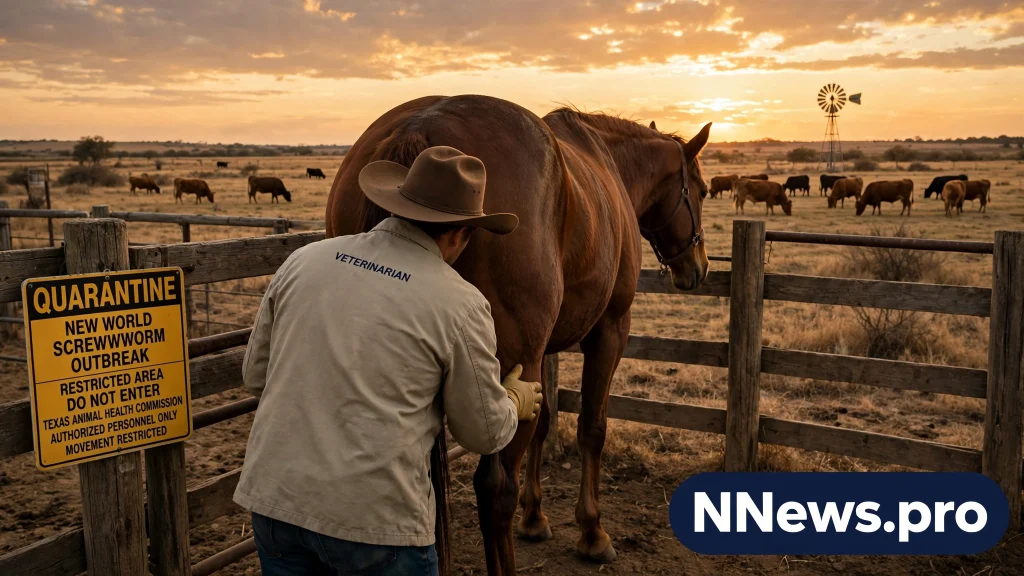
A confirmed case of New World screwworm in a Goliad County horse has pushed Texas’s animal quarantine zone to 31 counties, as state and federal officials race to contain a flesh-eating parasite that was declared eliminated from the United States in 1966.
The Texas Animal Health Commission reported the Goliad County detection on Thursday, November 12. Executive Director Dr. Lewis R. Dinges signed an order on Friday, November 13, establishing Infested Zone 36 in portions of the county, near the DeWitt-Goliad county line.
Movement frozen inside the new zone
Under the order, warm-blooded animals inside the designated zone cannot be moved outside its boundaries without prior authorization from the commission. Animals must be inspected and given any required treatment, and a commission representative must issue a movement permit or certificate before they can leave.
The restrictions also cover hides, carcasses and animal parts capable of hosting the pest, which must be inspected and treated before removal. The order took effect immediately and remains in place until the commission releases the quarantine. Unauthorized movement can result in administrative penalties or criminal prosecution.
Local officials have urged livestock owners to check their animals regularly. The Goliad County Livestock Coalition will hold a public meeting on Monday, November 16, at 6 p.m. in the District Courtroom of the Goliad County Courthouse, according to county extension agent Brian Yanta.
A parasite that attacks living tissue
New World screwworm flies lay eggs in the wounds or soft tissues of living warm-blooded animals. The larvae hatch and burrow into living tissue, and untreated wounds can worsen, develop secondary infections and become fatal, according to the commission.
The parasite can affect livestock, pets, wildlife and, less commonly, people. Livestock owners who suspect a case should contact their veterinarian or the Texas Animal Health Commission at 800-550-8242, which is staffed around the clock. Suspected wildlife cases should be reported to the Texas Parks and Wildlife Department, and people who suspect an infestation should contact a health care provider or the Texas Department of State Health Services.
Cases climbing across three states
The Goliad detection is part of a wider outbreak. According to the U.S. Department of Agriculture, 127 total animal cases had been reported as of Tuesday, November 10, with 125 of them domestic cases, and new confirmations since November 6 in Arizona, New Mexico and Texas.
USDA data compiled as of November 13 put the national total at 136 confirmed animal cases, 73 of them active, an increase of 15 in a single week. The most recent confirmations on November 13 involved two cattle and two horses.
In Texas, the commission reported 77 confirmed premises across 25 counties as of November 15, with the infested zone now covering 31 counties. A new modified executive order dated November 14 applies to Brewster and Terrell counties.
Neighboring states are watching closely. No cases had been confirmed in Oklahoma as of November 12, while California, which has had screwworm entry requirements in place since June, reported no cases as of November 11.
Related Articles



Why this matters
The outbreak threatens ranchers, the livestock trade and the food supply in one of the country’s largest cattle-producing states. Movement permits, inspections and quarantines add cost and delay for producers, and the steady eastward spread of the infested zone raises the stakes for states that have so far stayed clear.
The parasite’s return is also a public health story. The United States is already tracking a record measles year, and disease surveillance systems are under strain. Kenya discharged its last Ebola patient and began a 42-day countdown to declaring that outbreak over, a reminder that containment depends on fast detection and strict movement controls — the same tools Texas is now using against screwworm.
The University of Texas at Arlington is coordinating a $3.1 million project funded by the USDA to stop the spread of New World screwworm, with fieldwork in Texas and affected regions of Mexico running through June 2028.
Frequently asked questions
What is New World screwworm?
New World screwworm is a parasitic fly whose larvae feed on the living tissue of warm-blooded animals. Female flies lay eggs in open wounds or soft tissue, and the larvae burrow in, causing wounds that can become infected and fatal without treatment.
Can screwworm affect people or pets?
Yes. The parasite most commonly affects livestock, but it can also infest pets, wildlife and, less commonly, people. Anyone who suspects an infestation should contact a health care provider or the Texas Department of State Health Services.
What should livestock owners in Texas do?
Owners should inspect animals regularly for wounds and signs of infestation, contact a veterinarian or the Texas Animal Health Commission at 800-550-8242 if they suspect a case, and never move animals out of an infested zone without authorization, inspection and a permit.
Texas officials say the quarantine will stay in place until the commission is satisfied the area is clear. For ranchers in Goliad County and the 30 other counties now inside the infested zone, the message is simple: inspect every animal, report anything suspicious immediately, and do not move livestock without a permit.
Sources: South Texas News / Goliad Advance-Guard; Land Line Media; GenomicEpi (USDA data); The County Road (Texas Animal Health Commission data); University of Texas at Arlington.