ExxonMobil Approves $12.5 Billion Longtail Gas Project Offshore Guyana, Its First Built Around Gas
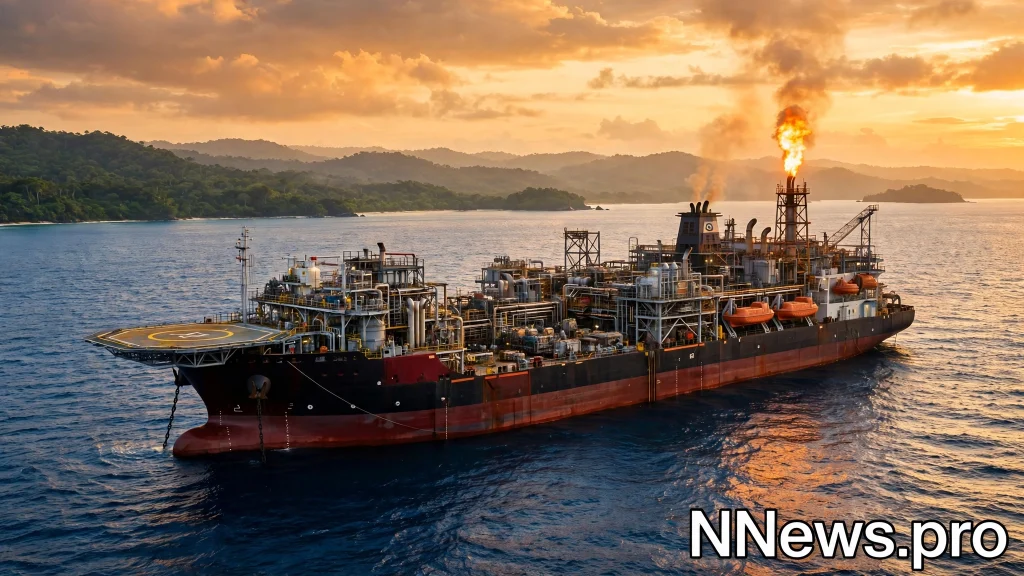
ExxonMobil has approved a $12.5 billion investment in the Longtail development offshore Guyana, the first project in the country’s prolific Stabroek block built around natural gas rather than oil. The company announced the final investment decision on Thursday, November 12, after securing government and regulatory approvals, with first production targeted for 2030.
Longtail will be the eighth development on the Stabroek block, located in its southeastern portion. Unlike the seven projects before it, which were designed to produce crude oil, Longtail targets non-associated gas and condensate-rich reservoirs — gas found in its own reservoirs rather than as a by-product of oil production.
A Floating Plant Built for Gas
The project will use a floating production, storage and offloading vessel, known as an FPSO, designed to process 1.2 billion standard cubic feet of gas per day and produce up to 250,000 barrels of condensate daily. Condensate is a light liquid hydrocarbon that comes out of the gas stream and sells much like very light oil.
About 45 subsea production and injection wells will feed the vessel, drawing from nine reservoirs, according to Guyana’s Ministry of Natural Resources. The ministry has estimated roughly 776 million barrels of condensate over the project’s 30-year life, though that is a projection, not a promise of sustained production at the vessel’s maximum rate. ExxonMobil Guyana operates the block with a 45 percent interest, alongside Hess Guyana Exploration at 30 percent and CNOOC Petroleum Guyana at 25 percent. Hess’s stake is now part of Chevron, which completed its roughly $53 billion purchase of Hess in July 2025.
What Happens to the Gas Is Not Yet Decided
One question the approval does not answer is what will happen to Longtail’s gas. ExxonMobil said the gas “could” be transported to shore by pipeline, but only subject to future investment decisions, market demand, and the development of the necessary infrastructure. In other words, the $12.5 billion approves building the wells and the vessel. It does not yet approve a pipeline to shore or a buyer once the gas gets there.
The licence requires a study of gas use and export, covering reservoir performance, production forecasts, potential export timing and markets. For Guyana, which has built its economy around oil since ExxonMobil produced its first barrel offshore in 2019, Longtail is the first test of whether the country can also become a gas producer.
Why This Matters
Guyana has become one of the fastest-growing oil producers in the world. Output is expected to pass one million barrels a day by late this year, and installed capacity across the Stabroek block is projected to reach 1.5 million barrels a day by 2029, rising further when Longtail comes online in 2030. Two other approved projects are already under construction: Whiptail, expected to begin production in 2027, and Hammerhead, expected to follow in 2029.
Related Articles


For ExxonMobil, Longtail extends a run of large offshore bets in South America. The company signed a non-binding deal with Venezuela’s state oil company PDVSA earlier this month to assess a return to that country after nearly 20 years, a separate move that underlines how much of the company’s growth plans now sit in the region.
Latest Developments
ExxonMobil said it and its contractors have spent more than $3.9 billion with Guyanese suppliers since 2015. Earlier in 2026, the company hired SBM Offshore to carry out front-end engineering and design studies for the Longtail FPSO, work that is now expected to move toward construction.
The approval follows a year in which attacks on Saudi Arabia’s East-West oil pipeline and other supply disruptions kept energy security high on the agenda for producers and consumers alike. Longtail’s 2030 start date, however, means its gas will arrive years from now, not in time to ease today’s market.
Frequently Asked Questions
What is the Longtail project?
Longtail is an offshore gas and condensate development in the Stabroek block off Guyana. ExxonMobil approved a $12.5 billion investment on November 12, 2026, and targets first production in 2030.
How much gas and condensate will Longtail produce?
The FPSO is designed to process 1.2 billion cubic feet of gas per day and produce up to 250,000 barrels of condensate daily. Those are design capacities, not guaranteed output.
Who owns the Longtail project?
ExxonMobil Guyana operates the Stabroek block with a 45 percent interest. Hess Guyana Exploration, now part of Chevron, holds 30 percent, and CNOOC Petroleum Guyana holds 25 percent.
Will Longtail gas be piped to shore in Guyana?
Not necessarily. ExxonMobil said gas could be piped to shore only if future investment decisions, market demand and infrastructure support it. That decision has not been made.
What Comes Next
With the final investment decision made, the focus shifts to building the FPSO and drilling the wells. The more consequential question for Guyana — whether Longtail’s gas ever reaches shore and fuels domestic industry — remains open, and the licence-required study of gas use and export will be the first sign of which way that decision goes.
Sources: ExxonMobil; OE Digital; InvestGuyana; TradingView / Seeking Alpha; Guyana Business Journal.