Iran Launches Second Drone Attack on US Radar in Bahrain in Three Days
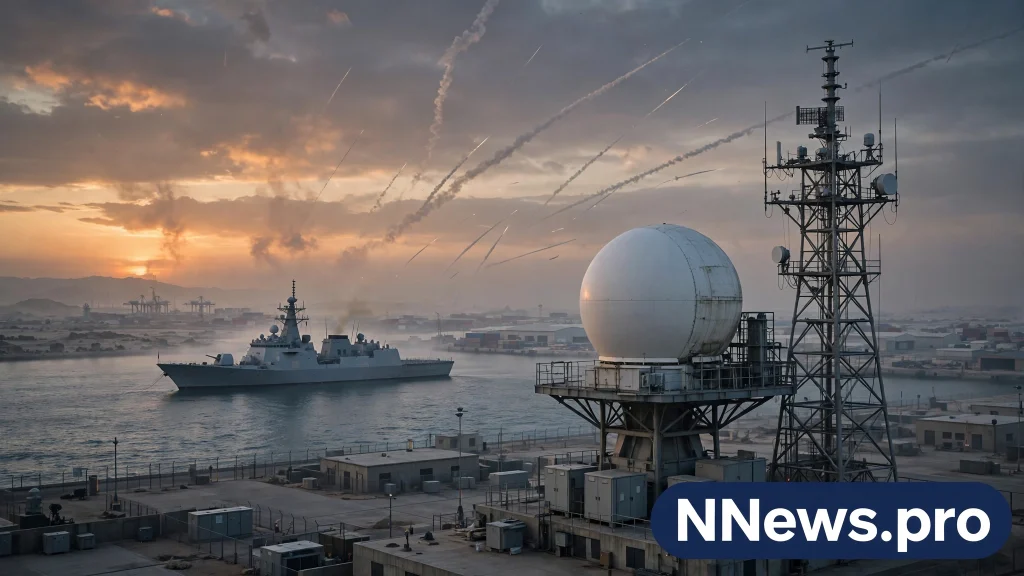
Iran’s Revolutionary Guards launched a second drone attack on a United States military radar in Bahrain early Sunday, three days after a first strike that Washington denied had caused any damage, as the confrontation between the two countries in the Gulf deepens.
Explosions were heard over Bahrain at about 4 a.m. local time (0100 GMT), an AFP journalist reported, with residents reporting a second series of blasts at about 6:30 a.m. Bahrain’s military said its air defences intercepted the attack, and the Interior Ministry issued two nationwide alerts urging residents to stay calm and seek shelter — the first such alerts since September.
What happened on Sunday
Iran’s Islamic Revolutionary Guard Corps (IRGC) said its Aerospace Force launched six drones at a US air-defence radar at the Al-Riffa helicopter base in Bahrain. The statement, carried by Iranian state broadcaster IRIB and the semiofficial Tasnim news agency, described the operation as the “second phase” of its retaliation for what it called hostile American actions.
The Guards said more drones were used in this phase than in the previous one, and warned that “the Strait of Hormuz is closed, and any aggression by the American enemy will be met with an even harsher and more forceful response.”
Bahrain’s Defence Force said its air defences intercepted and destroyed several Iranian aerial attacks before they could reach their targets. The Interior Ministry issued two public alerts in the early hours, the first at about 5:30 a.m. local time and a second later in the morning, telling citizens and residents to remain calm, go to the nearest safe place and get information only from official channels.
No injuries or damage had been reported by Sunday morning, and neither the United States nor Bahrain had confirmed any damage to the radar. The US military had not commented on Sunday’s attack at the time of reporting. No independent assessment has established what the six drones hit, whether any reached the base, or what damage they caused.
The first attack on Friday
Sunday’s strike followed a nearly identical claim on Friday, November 13, when the IRGC said it had targeted and destroyed a US early-warning radar in Bahrain in retaliation for an alleged air attack on a telecommunications tower in Sirik, on Iran’s Hormozgan coast, the day before. Read our earlier coverage: https://nnews.pro/iran-claims-strike-us-radar-bahrain/
US Central Command rejected that claim, saying its forces shot down two Iranian drones headed for Bahrain and that there were no injuries or damage. Read the follow-up: https://nnews.pro/us-shoots-down-iranian-drones-bahrain-radar-claim-denied/
The Associated Press reported at the time that neither the radar claim nor a separate IRGC claim of a mine strike on a liquefied petroleum gas tanker in the Strait of Hormuz could be independently verified.
Reuters reported that Friday’s attack was the first time Iran had claimed an attack on US military assets in a Gulf country since early September. The key difference on Sunday is that Bahrain itself confirmed an attack took place and said its defences had intercepted it, rather than the claim resting on the Guards’ broadcasts alone.
Why Bahrain matters
Bahrain hosts Naval Support Activity Bahrain, the headquarters of US Naval Forces Central Command and the US Navy’s Fifth Fleet, which oversees American naval operations across the Middle East. The Al-Riffa base, south of the capital Manama, is used by the US military.
The island kingdom was struck on February 28, the first day of the wider US-Iran confrontation, when the Bahrain Defence Force said it had shot down 45 missiles and nine drones. The current fighting began that day with American and Israeli strikes on Iran, and has continued in fits and starts despite a fragile lull in the autumn.
Just last week, President Donald Trump said the war was “effectively over” after talks with Qatar’s prime minister, while stressing that the US naval blockade of Iran would continue. Read that report: https://nnews.pro/trump-says-iran-war-effectively-over/
The two attacks on Bahrain in three days suggest the confrontation is far from settled.
US officials told the Wall Street Journal that Iran still has between 1,500 and 2,500 missiles, a stockpile that has allowed Tehran to keep launching attacks even after months of American and Israeli strikes on its launchers and air defences.
Related Articles


Why this matters
For the United States, the attacks test the credibility of its deterrence in the Gulf. The Fifth Fleet’s headquarters sits in Bahrain, and repeated Iranian strikes — even intercepted ones — force Washington to decide how to respond without triggering a wider war it has said it wants to avoid.
For the region, the strikes raise the risk of escalation at a moment when shipping through the Strait of Hormuz, the world’s most important oil chokepoint, is already under pressure. The IRGC’s claim that the strait is closed has not been independently confirmed, but any disruption to tanker traffic would push oil prices higher and rattle global markets.
For Bahrain, a small island state caught between its American ally and its much larger Iranian neighbour, the attacks are a direct security threat. The nationwide alerts on Sunday were the first since September, a sign of how seriously Manama is taking the renewed campaign.
Latest developments
The situation remains fluid. The US military had not issued a statement on Sunday’s attack at the time of reporting, and it is not yet clear whether Washington will respond publicly or militarily. Bahrain’s Defence Force said its air defences remain on alert.
Separately, the Saudi-led coalition said on Sunday it had shot down two Houthi missiles aimed at Riyadh and three drones, a further sign that the confrontation is widening across the region. The Houthis, who are aligned with Iran, have stepped up attacks on Saudi Arabia in recent days.
The United Nations Security Council last week extended its Yemen sanctions regime to November 2027, in part because of the Houthi escalation. Diplomats will be watching closely for any sign that the attacks on Bahrain and Saudi Arabia are part of a coordinated regional campaign.
Frequently asked questions
What did Iran claim on Sunday?
Iran’s Revolutionary Guards said six drones from its Aerospace Force targeted a US air-defence radar at the Al-Riffa helicopter base in Bahrain, describing the strike as the “second phase” of retaliation for hostile American actions.
Did the drones hit the radar?
That has not been independently confirmed. Bahrain’s military said its air defences intercepted and destroyed several Iranian aerial attacks before they reached their targets. No injuries or damage had been reported, and the US military had not commented on Sunday’s attack.
Why is the United States in Bahrain?
Bahrain hosts Naval Support Activity Bahrain, home to US Naval Forces Central Command and the Fifth Fleet, which oversees American naval operations in the Middle East. The base is a key part of the US military presence in the Gulf.
What happened on Friday?
On November 13, the IRGC claimed it had destroyed a US early-warning radar in Bahrain. US Central Command said it shot down two Iranian drones headed for the island, with no injuries or damage, and denied the radar had been hit. The claim could not be independently verified.
What to watch next
The key questions are whether Washington responds to the second attack, whether Iran launches a third phase, and whether the Strait of Hormuz remains open to shipping. Any American retaliation, satellite imagery of the Al-Riffa base, or disruption to tanker traffic would mark a significant escalation. For now, both sides are describing the same events in very different terms — and the gap between their accounts is itself a measure of how dangerous the standoff has become.
Sources: AFP via Arab News; Reuters; The Guardian; Al Jazeera; France 24; US Central Command; Bahrain Defence Force; Iranian state broadcaster IRIB.
- https://zarknews.com/blasts-and-sirens-in-bahrain-as-iran-claims-drone-attack-on-u-s-radar-base/
- https://geopolitiki.com/military/bahrain-first-nationwide-alert-since-september-irgc-says-six-drones-hit-us-air-defence-radar-riffa/
- https://khabarwire.com/blog/iran-drone-attack-bahrain-riffa-air-base-2026-11-15/
- https://dondoo.co.ke/2026/11/15/iran-fires-drones-at-us-base-in-bahrain-for-second-time-in-three-days/