SpaceX Plans $24 Billion Gas Plant and Super-Computer Hub in Texas
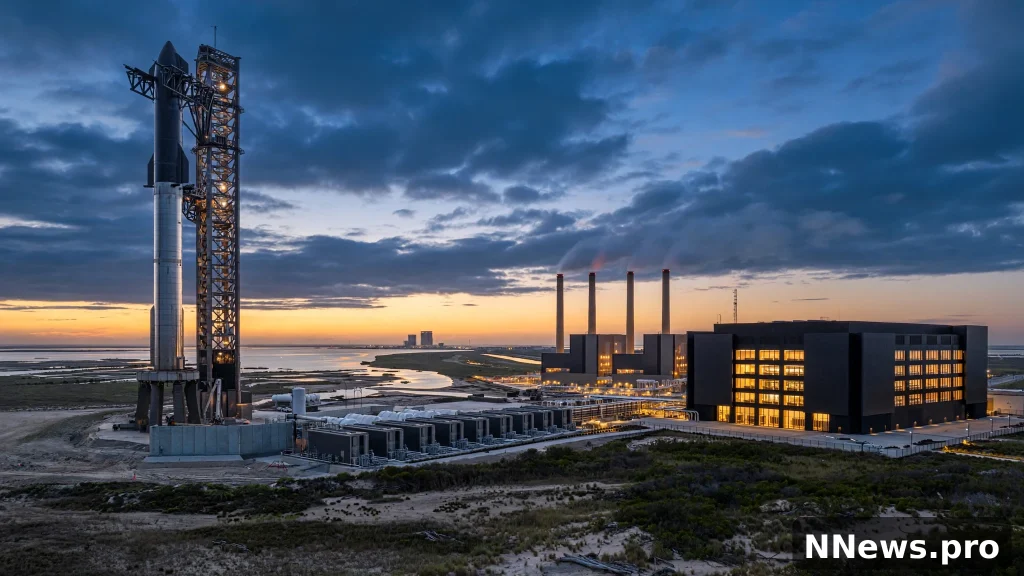
SpaceX is planning a roughly $24 billion gas-fired power plant and super-compute facility in Starbase, Texas, according to a public hearing notice from the city, in a move that would turn Elon Musk’s rocket-launch site into one of the largest artificial intelligence infrastructure projects in the United States.
The plan, first reported by Bloomberg and confirmed by Reuters on Monday, November 9, would see SpaceX build, own and operate both the power plant and the computing facility on a roughly 444-acre tract just east of Brownsville, between Boca Chica Boulevard and the Port of Brownsville. The $24 billion figure is the estimated capital investment for the project’s initial phases, and the notice says the work may be built in multiple phases with future expansions possible.
SpaceX has applied for a property tax abatement for the project. The Starbase City Commission will consider the abatement, along with a related economic development agreement, at a public meeting on December 9.
Power first, then compute
The most revealing detail in the notice is what SpaceX is not waiting for. Building its own gas-fired power plant would let the company skip a years-long wait to connect a project of this size to Texas’ main power grid, according to Reuters. For a company racing to build computing capacity for AI, that wait is the bottleneck.
The notice does not say how large the tax abatement would be or how long it would last. It also gives no details on the plant’s generating capacity or the scale of the computing operation. But a separate filing reported by the local RGV Business Journal suggests the scale is substantial: SpaceX has applied to Texas environmental authorities for an air emissions permit for a power generation facility with 35 natural gas turbines and a capacity of 748 megawatts.
That figure has not been confirmed in the city’s hearing notice, and SpaceX has not commented publicly on the project. Still, a 748-megawatt plant would be comparable in size to a mid-sized utility power station — far more than a rocket facility needs, and consistent with the enormous electricity appetite of AI super-computing.
The project would be among the largest private investments ever made in the Rio Grande Valley, according to the notice.
From rockets to AI
The Starbase plan is the latest sign of how far SpaceX has moved beyond its origins as a rocket company. SpaceX bought Musk’s AI lab, xAI, earlier this year, and the combined company has been expanding aggressively into artificial intelligence infrastructure.
Last month, SpaceX reported a 161 percent jump in revenue and a ninefold increase in AI revenue for its third quarter. The company has also been renting out computing capacity to Google, Anthropic and other major AI developers — a business that puts it in direct competition with the cloud giants it also supplies.
The Starbase facility would give SpaceX a computing hub of its own, powered by its own electricity, on land it already controls around its launch complex. Shares of SpaceX rose about 6 percent on Monday as the plans became public.
The gas supply chain is already taking shape. A SpaceX affiliate, Lone Star Mineral Development, has filed plans for an 8-mile natural gas pipeline to Starbase, called Starpipe, that is scheduled to enter service by January 2027. It will feed a planned plant that turns the gas into liquid methane for Starship rockets, according to filings Reuters reviewed in June.
Bloomberg also reported that SpaceX is planning a gas-fired power plant outside Houston to supply electricity to Terafab, an AI chip complex it is pursuing jointly with Tesla. That project, if it proceeds, would deepen the integration between Musk’s companies across rockets, AI chips and energy.
A political headwind
The Starbase plan arrives at an awkward political moment for data centers. Opposition to the facilities has been growing across the country, with voters rejecting data-center projects in 40 of 41 local ballot measures, according to Reuters. Democrats, some of whom campaigned on pausing new projects, took control of the U.S. Congress and the Texas governor’s office in last week’s midterm elections.
That shift matters for Starbase. Bloomberg noted that the project could face scrutiny under Texas’ incoming Democratic governor, Gina Hinojosa, who campaigned in part on curbing new data-center construction. Her administration would have a say over state-level permits and incentives, even though the December 9 decision on the tax abatement rests with the Starbase City Commission.
Starbase itself was only officially incorporated as a city in 2025. It is home to several hundred SpaceX employees and their families, and its government is closely intertwined with the company that built it — a fact that has already drawn scrutiny from critics who question whether a company town can fairly judge its own employer’s tax break.
Why this matters
For American consumers, the Starbase project is a window into the next phase of the AI boom. The race to build computing capacity is now colliding with the limits of the power grid, and the companies with the most money are responding by building their own power plants. That strategy is fast, but it raises questions about emissions, water use and who pays for the infrastructure that everyone else relies on.
Related Articles



For Texas, the project is a test of the state’s new politics. The state has courted data centers and energy projects for years with tax incentives and light regulation. A Democratic governor who campaigned against that model, combined with a midterm electorate that has been voting down data centers locally, could change the terms on which projects like Starbase proceed.
And for SpaceX, the stakes are strategic. The company is betting that owning the full stack — rockets, AI models, chips, computing and now the power to run it all — will give it an advantage that rivals who rent capacity cannot match. A $24 billion investment in Starbase is the clearest expression of that bet yet.
What to watch next
The first decision point is December 9, when the Starbase City Commission holds its public hearing on the tax abatement and the economic development agreement. The size and duration of any abatement, and the conditions attached to it, will show how much public support the project is receiving — and how much pushback it draws.
Beyond that, watch for the state environmental permit for the power plant, which will disclose its generating capacity and emissions, and for any response from the incoming Hinojosa administration. SpaceX has not said when construction would begin, and the notice makes clear the project could be built in phases over an extended period.
The story also bears watching for what it says about the AI industry’s energy appetite. If SpaceX, one of the world’s most valuable private companies, concludes that the grid cannot deliver power fast enough, other AI builders are likely to reach the same conclusion — and to build their own plants too.
Frequently Asked Questions
What exactly is SpaceX planning in Starbase, Texas?
SpaceX plans to build, own and operate a gas-fired power plant and a super-compute facility in Starbase, according to a City of Starbase public hearing notice. The estimated capital investment for the initial phases is about $24 billion, on a roughly 444-acre site east of Brownsville. The project may be built in multiple phases with future expansions.
Why is SpaceX building its own power plant?
Building its own gas-fired plant would let SpaceX avoid a years-long wait to connect a project of this size to Texas’ main power grid. AI super-computing requires enormous amounts of electricity, and grid connection queues for large loads can run for years.
When will the project be decided?
The Starbase City Commission will consider the project’s property tax abatement and a related economic development agreement at a public meeting on December 9, 2026. The notice does not give a construction start date, and the project could be built in phases.
Could Texas politics affect the project?
Possibly. Bloomberg noted the project could face scrutiny under incoming Democratic governor Gina Hinojosa, who campaigned on curbing new data-center construction. Voters have also rejected data-center projects in 40 of 41 recent local ballot measures. State permits and incentives could become points of contention, though the December 9 tax decision rests with the city.
Sources
- Reuters: “SpaceX plans $24 billion gas power plant, data center project in Texas” — https://www.reuters.com/legal/transactional/spacex-plans-24-billion-gas-power-plant-data-center-project-texas-2026-11-09/
- Stocktwits (citing Bloomberg): “SPCX Stock Rises As SpaceX Advances $24B Texas Data Center And Gas Plant Plans” — https://www.tradingview.com/news/stocktwits:ea2e77dcd094b:0-spcx-stock-rises-as-spacex-advances-24b-texas-data-center-and-gas-plant-plans/
- Chosun Biz (citing Bloomberg and Reuters): “SpaceX to invest 24 billion dollars in Texas AI power and supercomputing plan” — https://biz.chosun.com/en/en-it/2026/11/10/C77HLUNQAZHMDBFTDHUTJK4RHQ/
- NNews: “Anthropic Withdraws IPO Pricing Details From Banks After Nearly $70 Billion Plan Circulates” — https://nnews.pro/anthropic-ipo-pricing-details-retracted/
- NNews: “Senate Advances Sweeping Energy Permitting Bill in First Major Vote Since Midterm Elections” — https://nnews.pro/senate-advances-energy-permitting-bill-baaja/
- NNews: “Dow Jumps 1,104 Points as Stocks Stage Best Day Since April on Plunging Oil” — https://nnews.pro/dow-jumps-1104-points-stocks-rebound-oil-slides/