October CPI Rises 0.4% as Inflation Runs Hotter Than Expected, Strengthening the Case for a December Fed Hike
U.S. consumer prices rose 0.4 percent in October, the Bureau of Labor Statistics reported on Tuesday, topping the 0.3 percent increase economists had expected and keeping inflation pressure firmly in view ahead of the Federal Reserve’s final meeting of the year. Core prices, which strip out volatile food and energy costs, climbed 0.3 percent, also above the 0.2 percent forecast.
The report, released at 8:30 a.m. Eastern Time, is the last inflation reading the Fed will see before its December 8-9 meeting. It arrived hotter than Wall Street anticipated on both the headline and core measures, reinforcing expectations that the central bank will raise interest rates again next month.
In our October CPI preview, economists surveyed by Reuters had forecast a cooler month: headline prices up 0.3 percent after September’s 0.6 percent jump, and core prices up 0.2 percent. The Cleveland Fed’s nowcast had pointed to a similar outcome, estimating headline inflation at 0.24 percent and core at 0.21 percent. The actual figures beat both forecasts.
Shelter and food drove the increase
Shelter costs did much of the heavy lifting in October. The shelter index rose 0.3 percent, after a 0.4 percent increase in September, and the Bureau of Labor Statistics said shelter accounted for over 30 percent of the monthly all-items increase. Owners’ equivalent rent rose 0.3 percent, rent increased 0.2 percent, and lodging away from home climbed 0.6 percent.
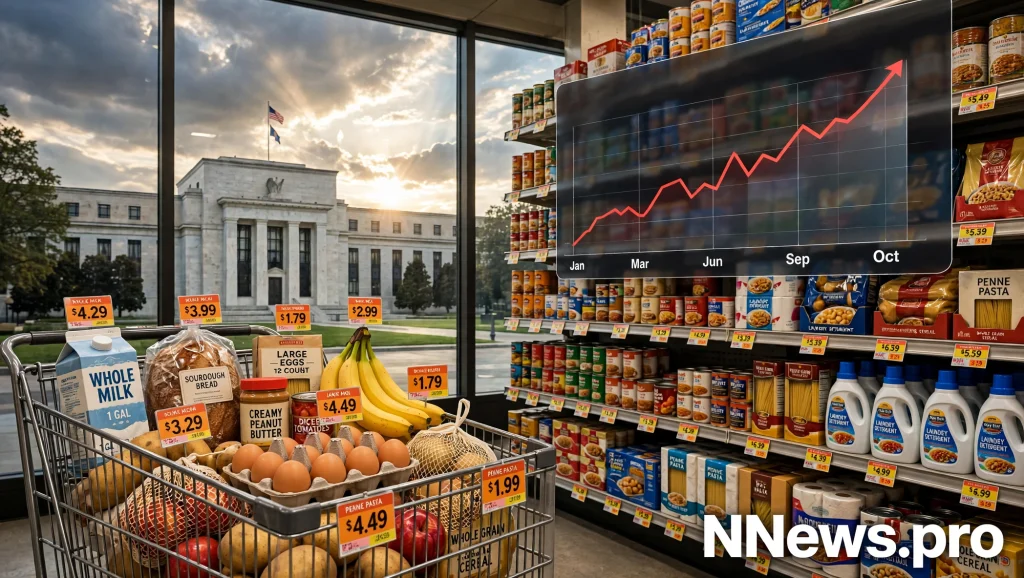
Food prices also picked up after a flat September. The food index rose 0.5 percent in October, with food at home up 0.4 percent and food away from home up 0.5 percent. Within grocery prices, other food at home rose 0.7 percent, led by snacks at 1.0 percent. Meats, poultry, fish and eggs increased 0.5 percent, including a 0.9 percent rise in beef. Fruits and vegetables rose 0.6 percent and dairy products rose 0.6 percent. Nonalcoholic beverages fell 0.3 percent, and cereals and bakery products were unchanged.
Energy prices cooled sharply from September’s surge but still rose. The energy index increased 0.7 percent in October, after jumping 5.2 percent in September. Gasoline rose 1.0 percent on a seasonally adjusted basis, a fraction of September’s 9.1 percent surge — and before seasonal adjustment, gasoline prices actually decreased 0.7 percent in October. Electricity rose 0.9 percent, while natural gas fell 0.8 percent.
The softer energy reading reflects, in part, the easing of the oil market. The Dow Jones Industrial Average jumped 1,104 points on Monday as Brent crude tumbled nearly 6 percent, after President Donald Trump said renewed strikes on Iran were highly unlikely while talks continue. Brent has now fallen more than 20 percent since the end of October as the war with Iran appeared to wind down, easing one of the main forces that pushed gasoline prices higher in September.
Elsewhere in the core index, recreation rose 0.8 percent and motor vehicle insurance climbed 0.7 percent. Medical care increased 0.3 percent, household furnishings and operations rose 0.2 percent, education gained 0.3 percent, and new vehicles edged up 0.2 percent. Used cars and trucks fell 1.2 percent and communication dipped 0.1 percent, among the few major categories that decreased.
On an unadjusted basis, the all-items index rose 0.2 percent for the month to 337.511, using the 1982-84 base of 100. The index for urban wage earners, known as CPI-W, rose to 331.147, up 0.1 percent before seasonal adjustment.
The missing number: no annual inflation rate
This month’s report carries an unusual gap. The Bureau of Labor Statistics did not publish the standard 12-month inflation rate for October — the figure most Americans know as “the” inflation rate — because it never collected price data for October 2025.
The gap traces back to the federal government shutdown that ran from October 1 through November 12, 2025. With price collection suspended, the bureau could not build an October 2025 index, and without that base month it cannot calculate a year-over-year change. In its release, the bureau explained: “BLS did not collect survey data for October 2025 because of a lapse in appropriations. For most CPI series, BLS could not publish October 2025 indexes. As a result, BLS cannot publish 12-month percent changes for October 2026 for indexes where October 2025 data are unavailable.”
That leaves analysts to estimate the annual rate on their own — and those estimates are not official figures. Bank of America estimated annual inflation at about 3.8 percent for headline prices and 2.7 percent for core, each a tenth of a point above September’s official readings of 3.7 percent and 2.6 percent. Economists cited by Reuters put the figures at roughly 3.9 percent and 2.7 percent. The last official annual reading, for September, was 3.7 percent for headline inflation and 2.6 percent for core.
The monthly figures, however, are complete and directly comparable. September’s headline increase of 0.6 percent was driven largely by a 9.1 percent surge in gasoline, which accounted for more than half of that month’s rise. October’s 0.4 percent increase was broader, with shelter and food doing more of the work and energy contributing far less.
Why this matters: the Fed’s December decision
The October report lands at a decisive moment for monetary policy. The Federal Reserve raised its benchmark rate to a range of 3.75 percent to 4.00 percent in September — its first increase since 2023 — and held it there on October 28 in a 10-2 vote, with Lisa Cook and Beth Hammack dissenting in favor of another quarter-point hike. The Fed’s next meeting, on December 8 and 9, is its last of the year, and the October CPI report is the final inflation data it will receive beforehand. The November report is not due until December 10, the day after the meeting ends.
Related Articles


Before Tuesday’s release, traders had already priced in a strong chance of a December hike. Market-implied odds of a quarter-point increase stood near 75 to 84 percent, according to CME FedWatch and other measures, after a strong October jobs report — 165,000 jobs added, with unemployment ticking down to 4.1 percent — firmed expectations of another move.
Federal Reserve Governor Christopher Waller, speaking in London on Tuesday, said he leaned toward backing a quarter-point increase in December, while warning that a hot October inflation reading could justify a half-point move. Waller said inflation remains too elevated and that a merely quarter-point step after a strong report could put the central bank’s credibility at risk. His remarks, made before the figures were released, now read as a direct preview of the debate inside the Fed: with headline inflation at 0.4 percent and core at 0.3 percent, both above forecast, the case for a larger move has grown louder.
The hotter-than-expected print also complicates the outlook for households. Shelter, the largest single component of the consumer price index, has now risen for months, and food prices accelerated after standing still in September. For families, that means the cost of housing and groceries — the two categories that dominate most budgets — kept climbing in October even as gasoline gave back some of September’s surge.
Latest developments
The report was published at 8:30 a.m. Eastern Time on Tuesday, and traders were still digesting the figures as the trading day began. The key questions now are how the Fed’s policymakers respond in their public remarks this week — several officials, including Waller, Dallas Fed President Lorie Logan and Kansas City Fed President Jeffrey Schmid, are scheduled to speak — and whether the hotter print shifts market pricing for December toward a half-point increase.
Attention will also turn to the October Personal Consumption Expenditures price index, the Fed’s preferred inflation gauge, due later in November, and to the November CPI report on December 10. Because the bureau published an index for November 2025, the December release should restore the standard year-over-year comparison that is missing this month.
Frequently asked questions
Why is there no annual inflation rate for October?
The Bureau of Labor Statistics could not collect price data in October 2025 during the federal government shutdown, so it has no base month to compare against. It therefore published no 12-month percent changes for most series in the October 2026 report. Unofficial estimates put the annual rate near 3.8 to 3.9 percent, but those are analysts’ calculations, not official figures.
What does the report mean for the Fed’s December meeting?
It strengthens the case for another rate hike. Headline inflation rose 0.4 percent and core rose 0.3 percent, both above forecasts, and Fed Governor Christopher Waller had already said a hot reading could justify a half-point increase. Before the release, markets priced roughly a 75 to 84 percent chance of a quarter-point hike on December 8-9.
Which prices rose most in October?
Food rose 0.5 percent after being flat in September, shelter rose 0.3 percent and accounted for over 30 percent of the monthly increase, and recreation rose 0.8 percent. Gasoline rose only 1.0 percent after September’s 9.1 percent surge, and actually fell 0.7 percent before seasonal adjustment. Used cars and trucks fell 1.2 percent.
When is the next inflation report?
The November CPI report is scheduled for Thursday, December 10, 2026 — the day after the Fed’s December meeting ends. The October Personal Consumption Expenditures price index, the Fed’s preferred measure, is due later in November.
Consumer prices are still rising faster than the Federal Reserve wants, and October’s report gave the central bank little reason to pause. With shelter and food leading the increase, the figures beat forecasts on both the headline and core measures, and the missing annual rate does nothing to soften the message. The next signal comes from the Fed itself: its December meeting is four weeks away, and after Tuesday’s numbers, another rate hike looks more likely than not.
Sources:
- U.S. Bureau of Labor Statistics, Consumer Price Index — October 2026: https://www.bls.gov/news.release/cpi.nr0.htm
- Reuters economists’ survey on October CPI expectations: https://headlinesxtra.com/2026/11/10/us-inflation-forecast-to-ease-october-fed-rate-hike-risks-persist/
- Morningstar, “Hot October Jobs Report Raises Odds of December Rate Hike”: https://www.morningstar.com/economy/hot-october-jobs-report-raises-odds-december-rate-hike
- IndexBox, “Waller Backs 25-Basis-Point December Rate Hike”: https://www.indexbox.io/blog/feds-waller-leans-toward-quarter-point-rate-hike-in-december-warns-of-50-basis-point-move-if-inflation-runs-hot/
- CNBC / Dow Jones consensus: https://www.binance.com/en/square/post/11-10-2026-october-cpi-seen-up-0-3-keeping-fed-on-course-for-december-rate-increase-386629545140528