Trump Urges Congress to Pass Federal Film Tax Credit After White House Meeting With Jon Voight
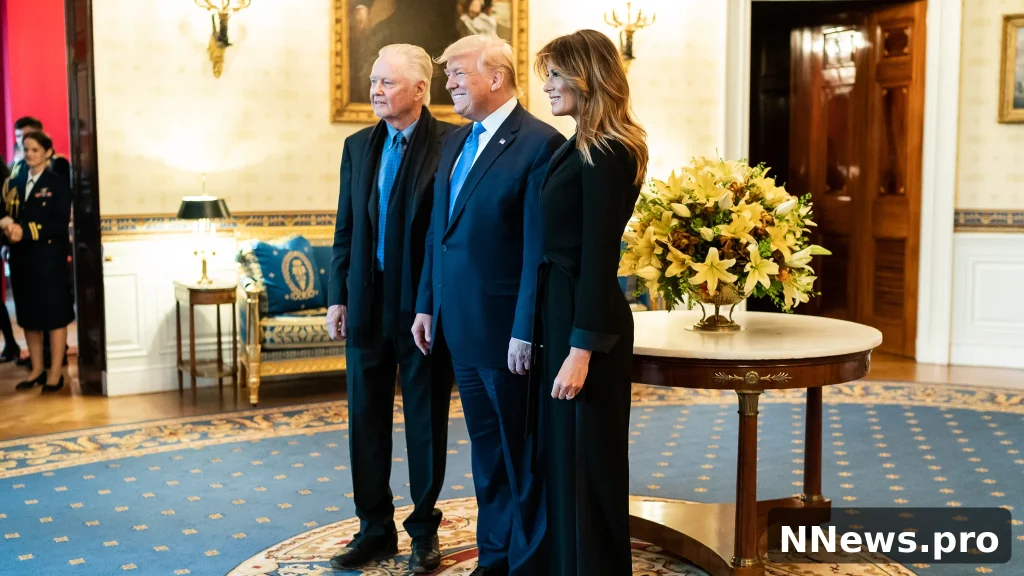
President Donald Trump urged Congress on Friday to pass a federal tax credit for film and television production, renewing his push for the measure after a White House meeting with actor Jon Voight — even as a nationwide ground stop halted flights across the country.
Voight, producer Steven Paul and SP Media Group president Scott Karol met with Trump to press him to make the incentive a priority during Congress’s lame-duck session. While the group was still in the room, the president posted on Truth Social that he was working with lawmakers from both parties to advance the legislation.
“Meetings are being set up, routinely, with the Leaders of both Parties in order to, GET THIS DONE!” Trump wrote. “It is a very Bipartisan undertaking, especially in that so much of the money being lost to other countries is coming out of the Blue States. Hopefully Republicans and Democrats will get together and finalize this already very actively negotiated Legislation.”
A meeting held during two emergencies
The timing of the meeting drew attention. Trump was receiving updates throughout the session about the nationwide ground stop that grounded departing flights across the United States on Friday after a major air traffic control communications failure, and about a capsized river cruise ship in New Orleans.
“It was exciting to watch,” Karol told Variety. “He’s concerned with different things because he’s the president. He gave us attention while taking care of two emergencies.”
Paul said Voight delivered an impassioned appeal for the bill, telling Trump he had “a helpful heart” and believed the measure could pass. Paul added that Voight was in tears by the end of the meeting.
Trump said he was working with Senator Tim Scott, a Republican, and Senator Adam Schiff, a Democrat — “believe it or not,” the president wrote — along with Senators John Cornyn, Raphael Warnock, Steve Daines, Bernie Moreno, Tim Sheehy, Alex Padilla, Mark Warner, Thom Tillis, Chris Coons, Katie Britt and Dick Durbin, and Representatives Jason Smith, Nathaniel Moran, Brian Jack, Linda Sanchez and others, on the Motion Picture, Television, and Entertainment Revitalization Act.
Schiff responded on X, writing, “President Trump and I agree: it’s time for Congress to pass a federal film incentive.” He said the bill should not wait until Democrats take control of Congress in January.
What the bill would do
The bill, introduced on a bipartisan basis on September 24, would create the first federal production incentive in the United States. It would offer a 20 percent transferable tax credit on qualifying domestic production wages, covering work above and below the line as well as post-production and visual effects.
The credit could rise to a maximum of 30 percent with 5 percent bonuses, including one for independent productions and one for shoots in disaster zones, such as parts of Greater Los Angeles after the 2025 fires. Films, scripted and unscripted television shows and pilots with a minimum spend of $1 million would be eligible, provided at least three-quarters of the shoot takes place in the United States. The federal credit could be stacked with existing state incentives.
Trump first publicly backed a federal incentive in August, after Voight, Paul and Karol presented him with data from an upcoming study by the consultancy Olsberg SPI. Before his second inauguration, Trump had named Voight, Mel Gibson and Sylvester Stallone as his “special ambassadors” to Hollywood, tasked with bringing production back to the United States.
Related Articles



The trio had lobbied Trump for more than a year, first at his Mar-a-Lago estate in the spring of 2025 and again at a White House screening in February 2026, before the August meeting sealed the president’s support.
Why it matters
Supporters say the incentive is needed to stop productions from leaving the United States for countries such as the United Kingdom and Canada, which offer generous production support. The Olsberg SPI study, published in September, estimated that a federal credit would generate about $125 billion in additional production spending from 2027 to 2035, and that the American share of global production spending could nearly double to 65 percent by 2030. Without the bill, the study warned, the United States’ share could fall to 25 percent, from 34 percent of $13.7 billion in global film spending in 2025.
The industry is pushing for passage before the end of the year. At this week’s American Film Market in Los Angeles, producers urged Congress to act while Trump’s endorsement and the bipartisan coalition remain in place, with one panel adopting the slogan “We need to bring Tom Cruise home.”
Critics question the cost. The libertarian-leaning Cato Institute has estimated the incentive would cost between $33 billion and $49 billion over 10 years, or $3.3 billion to $4.9 billion a year.
What happens next
The path through Congress is uncertain. Politico reported on Friday that the effort had run into difficulties after the midterm elections, in which Democrats won control of both chambers. Representative Don Beyer, a Virginia Democrat, told the publication that the chances of passing any tax bill during the lame-duck session were “pretty low.”
With the Senate targeting a December 18 adjournment, supporters have roughly five weeks to attach the measure to a year-end tax package or another must-pass bill. Legislation left unfinished when the current Congress ends would have to be reintroduced in the new Congress, which convenes on January 3, 2027.
Producers say timing also matters for planning: they want productions to be able to give a January 1, 2027 start date so their films can qualify. For now, the bill’s fate rests on whether the bipartisan coalition Trump is assembling can find a legislative vehicle before the lame-duck session ends.
Frequently Asked Questions
What is the proposed federal film tax credit?
It is a 20 percent transferable tax credit on qualifying United States production wages under the Motion Picture, Television, and Entertainment Revitalization Act, rising to a maximum of 30 percent with bonuses for independent productions and shoots in disaster zones. It would be the first federal production incentive in the country.
Who supports the bill?
The bill was introduced on a bipartisan basis in September, sponsored in the Senate by Tim Scott and Adam Schiff and backed in the House by members of both parties. President Trump supports it, as do the Motion Picture Association and producers’ groups, while the Cato Institute has questioned its cost.
What happens if Congress does not pass it this year?
The bill would have to be reintroduced in the new Congress that convenes on January 3, 2027, and producers would lose the January 1, 2027 start date they want for qualifying productions.
Sources
Variety; Deadline; Politico; Screen Daily; Screen Global Production; SSBCrack News; AmeriLedger; Europe Says.