Trump’s Judge-Appointment Blitz Hits Resistance From Fellow Republicans
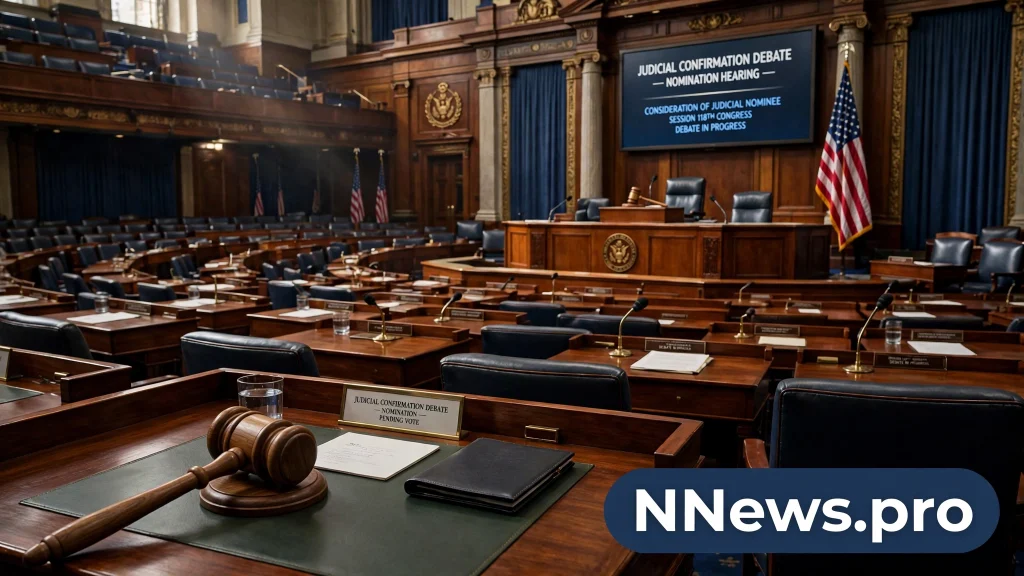
President Donald Trump’s last-minute push to install as many judges as possible before Democrats take control of the Senate in January is running into resistance from some fellow Republicans, with a handful of senators blocking or casting doubt on three of his nominees.
The White House and Senate Republican leaders are pressing ahead with judicial confirmations during the lame-duck session, but outgoing Republican members of the Senate Judiciary Committee have shown they are willing to stand in the way of nominees chosen for their home states.
A race against the January deadline
Trump’s team is racing the clock. Democrats won at least 54 seats in the November 3 midterm elections and will take control of the Senate in January, closing the window for confirming the president’s picks without Democratic support.
Senate Republicans have routinely approved Trump’s nominees for lifetime seats on district and appeals courts during his second term, confirming 57 so far and helping him cement a conservative imprint on the judiciary that will outlast his presidency. Senate Majority Leader John Thune said on Monday that judicial confirmations were a top priority while Republicans retain control of the chamber, and the Senate confirmed its first judicial nominee of the lame-duck session on Thursday.
Twenty-three nominees remain pending, including Colorado-based U.S. District Judge Daniel Domenico, whose nomination to the Denver-based 10th U.S. Circuit Court of Appeals is set for a vote on Monday.
The Rudofsky reversal
The clearest sign of the friction came on Tuesday, when the White House took the rare step of withdrawing U.S. District Judge Lee Rudofsky’s nomination to the St. Louis-based 8th U.S. Circuit Court of Appeals and replacing him with Arkansas Supreme Court Justice J. Cody Hiland.
Rudofsky’s prospects dimmed after Arkansas’ two Republican senators, John Boozman and Tom Cotton, opposed him and favored Hiland instead. According to the Associated Press, Republican Senators John Cornyn of Texas and Thom Tillis of North Carolina privately informed Judiciary Committee Chairman Chuck Grassley that they would oppose Rudofsky’s nomination in committee, effectively threatening to block its advancement.
Rudofsky, a first-term Trump appointee known for a ruling that weakened enforcement of a major voting rights law, acknowledged the reality in a statement. “The reality is that, without the support of my home-state senators, confirmation is simply not a practical possibility in today’s Senate,” he said.
Hiland, who has served on Arkansas’ top state court since 2023, said at an August event that he had expected to receive the appeals court nomination but was instead offered a federal district judgeship, which he declined. He is now expected to appear before the Judiciary Committee on November 18.
The 8th Circuit hears cases from federal courts in Arkansas, Iowa, Minnesota, Missouri, Nebraska, North Dakota and South Dakota. Rudofsky’s confirmation would have made it the first federal appeals court in America where a majority of judges are Trump appointees.
Two more nominees in doubt
Rudofsky is not the only nominee facing trouble. Cornyn has separately declined to commit to supporting T. Elliot Gaiser, Trump’s nominee for a federal judgeship in Dallas. Tillis is likewise backing Sen. Armstrong’s opposition to Zach West, a lawyer in the Oklahoma attorney general’s office who has drawn praise from conservative legal activists for defending abortion restrictions and supporting the participation of religious schools in Oklahoma’s charter school program.
Tillis and Cornyn are both outgoing members of the Senate Judiciary Committee, and both can deny nominees the votes needed to advance. Tillis is retiring, and Cornyn lost a primary to a Trump-backed challenger, leaving both men in their final days in office and, by Reuters’ account, willing to block some nominees pending before the committee.
Related Articles

Tillis, who has a fractured relationship with Trump, told reporters on Thursday that the White House has at times essentially told senators, “This is our guy, I hope you’ll get on board.”
Why this matters
The stakes go beyond three nominations. Trump made 234 judicial appointments during his first term in office from 2017 to 2021, including three members of the Supreme Court’s current 6-3 conservative supermajority. Every lifetime appointment confirmed in the coming weeks will shape American law for decades, long after the current administration leaves office.
The lame-duck scramble also tests how much control Trump still holds over his own party after the midterm losses. Republican senators who once approved his nominees without hesitation are now using their remaining leverage to steer picks toward their own preferred candidates, even at the cost of slowing the president’s agenda.
For the White House, the Rudofsky episode is a warning. A nominee can have the president’s backing, a hearing already behind him and a committee vote in sight, and still be pulled if home-state senators object. With Democrats set to take the Senate in January, the administration has little time left to recover from each setback.
What happens next
The immediate test comes on Monday, when Domenico’s nomination to the 10th Circuit is scheduled for a vote. Hiland’s committee hearing is expected on November 18, and the White House must still decide whether to fight for Gaiser and West or replace them as it did with Rudofsky.
Thune has made clear that confirmations remain the Senate’s top priority in the lame-duck session. Whether the remaining 23 pending nominees all reach a vote before January will depend on how quickly the White House can resolve the objections from within its own party.
Frequently asked questions
Why is Trump rushing to confirm judges now?
Democrats won at least 54 seats in the November 3 midterm elections and will take control of the Senate in January. Once that happens, confirming Trump’s nominees will require Democratic support, so the White House is trying to confirm as many as possible during the lame-duck session.
Who is Lee Rudofsky, and why was his nomination withdrawn?
Rudofsky is a U.S. District Judge in Arkansas whom Trump nominated to the 8th U.S. Circuit Court of Appeals. The White House withdrew the nomination on Tuesday, November 10, after Arkansas’ Republican senators, John Boozman and Tom Cotton, opposed him and favored Arkansas Supreme Court Justice J. Cody Hiland instead.
Which other nominees are facing Republican resistance?
Sen. John Cornyn has not committed to supporting T. Elliot Gaiser, Trump’s nominee for a federal judgeship in Dallas. Sen. Thom Tillis is backing Sen. Armstrong’s opposition to Zach West, a lawyer in the Oklahoma attorney general’s office, for a judicial nomination.
How many judges has Trump confirmed in his second term?
Senate Republicans have confirmed 57 of Trump’s judicial nominees so far in his second term, with 23 nominees still pending. In his first term, Trump made 234 judicial appointments, including three Supreme Court justices.
The lame-duck fight over judges is far from over. With 23 nominees still pending and Democrats set to take the Senate in January, the White House has weeks, not months, to finish a confirmation push that its own party’s senators are now slowing down.
Sources: Reuters; Bloomberg Law; Nomination Notes (citing AP); Reason/Volokh.