Supreme Court Clears Way for Border Wall Construction in Texas’ Big Bend
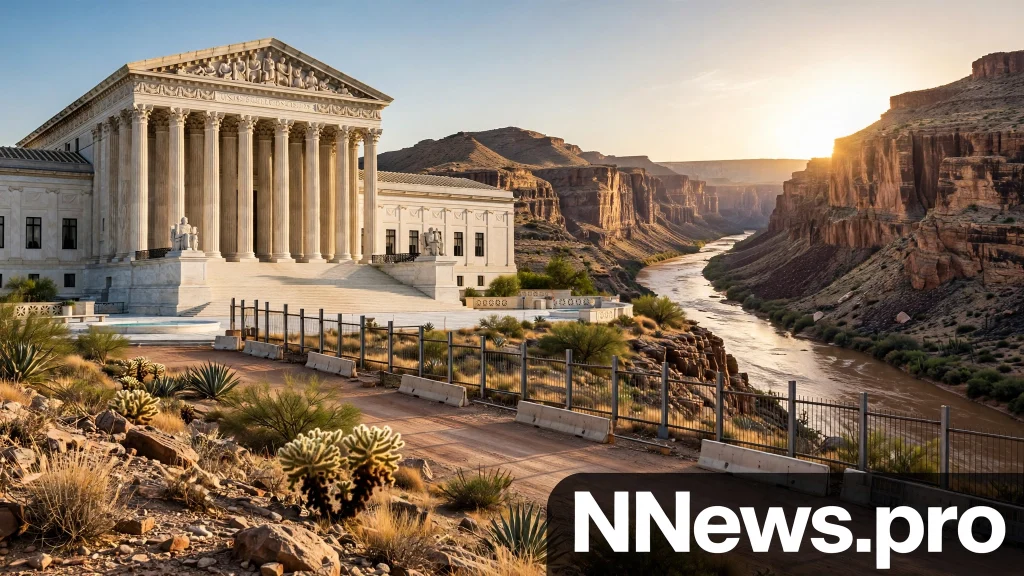
The U.S. Supreme Court on Monday cleared the way for the Trump administration to resume building border barriers and roads in the Big Bend region of West Texas, lifting a federal judge’s order that had stopped the work in October and handing the president a win on one of his longest-running priorities.
In a brief unsigned opinion in Mullin v. Friends of the Ruidosa Church, the justices granted the government’s emergency request to stay a preliminary injunction issued by U.S. District Judge Kathleen Cardone of the Western District of Texas. Justice Ketanji Brown Jackson was the only member of the court who said she would have denied the request.
The ruling allows construction crews to return to a remote stretch of the U.S.-Mexico border that includes Big Bend National Park while the underlying lawsuit continues. The court declined, however, to grant the administration’s separate request to summarily reverse Judge Cardone’s ruling outright, according to SCOTUSblog, leaving the case itself unresolved.
A 1996 law at the center of the fight
The case turns on a 1996 law, Section 102 of the Illegal Immigration Reform and Immigrant Responsibility Act, known as IIRIRA. The law lets the secretary of homeland security build barriers and roads “to deter illegal crossings in areas of high illegal entry” and waive “all legal requirements” needed to speed construction. It also limits courts to hearing only claims that the Constitution was violated.
Earlier this year, Homeland Security Secretary Markwayne Mullin and his predecessor, Kristi Noem, issued waivers of environmental and conservation laws for construction in the Border Patrol’s Big Bend Sector, which the department designated an area of high illegal entry. The waivers let the government bypass dozens of federal and state protections covering the environment, air and water, historic landmarks, Native burial grounds, endangered rivers, lands and species.
A river guide, the Center for Biological Diversity and a nonprofit formed to preserve a historic adobe church in Ruidosa, Texas, sued. On October 2, Judge Cardone blocked the waivers and halted construction, finding the challengers were likely to win under the major-questions doctrine because Congress had not clearly authorized such sweeping waivers in a sector with relatively few crossings.
The Supreme Court disagreed — at least for now. The justices said the government is “exceedingly likely to prevail” on its argument that Judge Cardone lacked jurisdiction to hear the case at all. “However it is labeled,” the challengers’ claim alleges that the secretary exceeded his statutory authority, not that he violated the Constitution, the court wrote. “There is no such thing as a ‘constitutional’ major-questions claim.”
The cost of the delay
The court also pointed to a declaration from a Customs and Border Protection official saying the injunction was costing the government nearly half a million dollars a day, money that “cannot be recouped.” Congress, in writing the waiver provision, made “a clear preference for expeditious border construction” over the kinds of harms the plaintiffs described, the justices wrote, and the government’s interest “outweighs any aesthetic, recreational, and environmental harm” they alleged.
The administration’s plans call for more than 300 miles of six-foot-tall vehicle barriers and supporting roads across the region, relying on the 1996 waiver authority. Customs and Border Protection has awarded five contracts worth more than $6 billion for border security upgrades in Big Bend, including 30-foot steel fencing, vehicle barriers and surveillance technology the agency calls its “smart wall.” According to CBP Commissioner Rodney Scott, the wall is being built at a pace of about 12 miles a week and is expected to be completed by the end of President Donald Trump’s second term.
Plans inside Big Bend National Park itself were scaled back after public outcry. The original proposal included a physical wall through the park; it was changed to vehicle barriers, roads and surveillance technology, according to ABC News. CBP figures show only about 1 percent of migrant encounters occur in the Big Bend Sector, a fact the challengers have used to argue the sweeping waivers were never justified.
What happens next
The stay remains in place while the government pursues a full appeal, and it ends automatically if the justices decline to take up the case, according to the order. The lawsuit itself continues in the lower courts, where the challengers can still argue that the waivers are unlawful — but the construction they sought to stop can now proceed in the meantime.
Related Articles


Opponents condemned the order. “This horrific decision clears the way for contractors to bulldoze pristine desert and dynamite canyon walls before the courts have even decided whether this destruction is legal,” said Laiken Jordahl of the Center for Biological Diversity, according to ABC News.
The ruling is the latest in a series of emergency decisions in which the court’s conservative majority has sided with the administration’s use of fast-track authority. It also fits a broader pattern in the president’s second term: using decades-old statutes to move major projects forward quickly, as the Senate did this week when it advanced a sweeping energy permitting bill that would fast-track power plants, pipelines and mines.
Why this matters
For the administration, the decision removes the last legal obstacle to a project it has treated as a symbol of its border policy, and it does so with a legal theory that could apply well beyond Texas. If the Supreme Court ultimately agrees that challenges to the secretary’s waiver authority cannot be heard in court except on constitutional grounds, future administrations would face a much narrower path for opponents of border construction to slow or stop it.
For the challengers, the practical effect is immediate: heavy equipment can return to a landscape they describe as one of the most ecologically sensitive on the southern border before a court has ruled on whether the waivers were legal in the first place.
For residents and visitors, the decision means the remote desert of the Big Bend — home to Big Bend National Park, the Rio Grande and the fragile adobe church in Ruidosa at the heart of the case — will see construction resume within days, with the federal government arguing that speed is precisely what Congress intended.
Latest developments
The stay was granted on Monday, November 9, and construction is expected to resume promptly. The administration has not said when crews will return to the site. The challengers’ case continues, and the Supreme Court will decide later whether to hear the full appeal. The Department of Homeland Security has not commented publicly on the ruling beyond the court filings.
Frequently asked questions
What did the Supreme Court decide about the Big Bend border wall?
The court granted the Trump administration’s emergency request to pause a federal judge’s injunction that had halted border barrier construction in the Big Bend region of West Texas. Construction can now resume while the lawsuit against the project continues. Only Justice Ketanji Brown Jackson said she would have denied the request.
What law lets the government waive environmental rules for the wall?
Section 102 of the 1996 Illegal Immigration Reform and Immigrant Responsibility Act lets the secretary of homeland security waive “all legal requirements” to build barriers and roads quickly in areas of high illegal entry. The Supreme Court said the law likely prevents courts from hearing challenges to those waivers unless they allege a constitutional violation.
Does the ruling end the lawsuit?
No. The ruling is temporary. The stay remains in place while the government pursues a full appeal, and the underlying lawsuit over whether the waivers are lawful continues in the lower courts. The court also declined to summarily reverse the lower court’s ruling outright.
How much of the border wall is planned in Big Bend?
The administration plans more than 300 miles of six-foot vehicle barriers and supporting roads in the region, backed by five CBP contracts worth more than $6 billion. Inside Big Bend National Park, the plan now calls for vehicle barriers, roads and surveillance technology rather than a physical wall.
What to watch next
The key question now is whether the Supreme Court agrees to hear the full case, which would settle whether the secretary’s waiver power under the 1996 law is effectively beyond judicial review. In the meantime, the pace of construction — about 12 miles a week, according to CBP — will be the most visible measure of the ruling’s impact, along with any further legal challenges from the environmental groups and the church preservationists who brought the case.
Sources:
- Reuters, “Supreme Court allows Trump border wall at Big Bend National Park in Texas,” November 9, 2026.
- Texas Gazette, “Supreme Court Clears Way for Big Bend Border Wall Work to Resume,” November 10, 2026, citing the Supreme Court order in Mullin v. Friends of the Ruidosa Church (No. 26A560), SCOTUSblog, ABC News and NBC News.
- The Guardian, “US Supreme Court Clears Way for Trump’s Border Wall in Texas’s Big Bend,” November 9, 2026.








[…] last week admitting his role in the July 2022 robbery, according to court documents filed Monday in federal court in Los Angeles. He is expected to formally enter his guilty plea at a hearing set for November […]