EU Names Five-Country Team to Represent Europe at Ukraine Peace Talks
EU Names Five-Country Team to Represent Europe at Ukraine Peace Talks
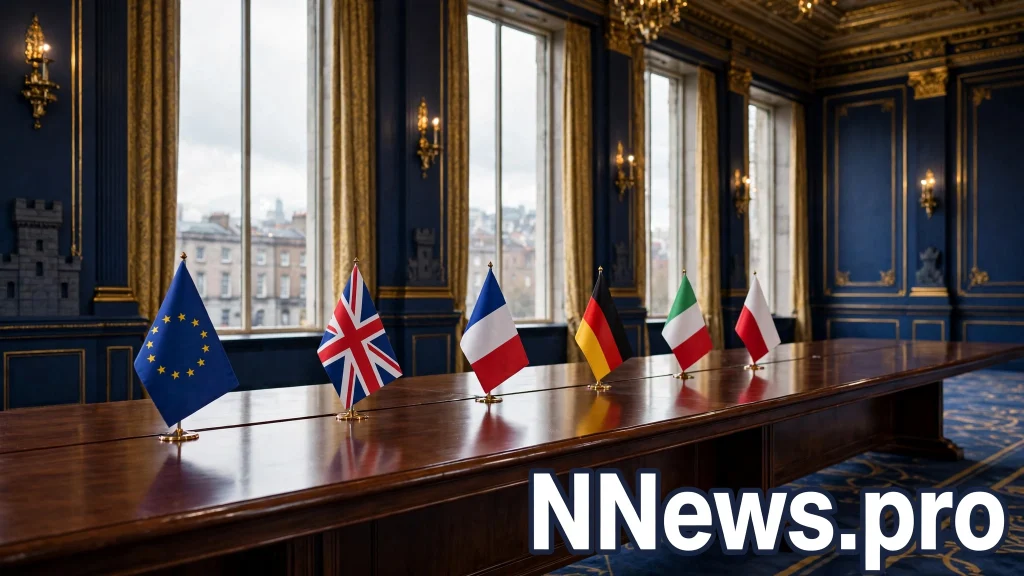
European leaders have settled one of the most persistent questions of the war in Ukraine: who speaks for Europe when the next round of peace talks begins. After an informal summit in Dublin on Friday, November 13, European Council President Antonio Costa announced that Europe will be represented by the European Union’s institutions together with five countries — the United Kingdom, France, Germany, Italy and Poland.
The decision gives institutional form to a European demand for a seat at the table in a diplomatic process driven so far by Washington, Kyiv and Moscow. It comes days after the first direct talks between Russia and Ukraine in nine months, and it still leaves the biggest question unanswered: whether the Kremlin will actually let the Europeans into the room.
“We need to integrate all of us. And for this it’s essential to have a team and to speak with only one voice,” Costa said. “Europe must speak with one clear voice and united voice in all discussion that shape the future of Ukraine and the security of our continent.”
Who sits on the team
The five countries are Europe’s major military powers: four European Union member states plus Britain, which left the bloc in 2020 but remains part of the Coalition of the Willing, the group of more than 30 countries backing Ukraine and preparing security guarantees for any future ceasefire.
The team has two parts: the national governments and delegates from the European Union’s institutions, the European Commission and the European Council. The arrangement is known in diplomatic shorthand as the E5, and it will work with all 27 EU member states while coordinating Europe’s contribution alongside Ukraine, the United States and NATO. EU officials said the representatives were likely to be national security advisers from the five powers, plus delegates from the Commission and the Council, with NATO also expected to be represented. The exact names have not yet been settled.
The European Council was explicit about the limits of the team’s mandate: it is not there to negotiate Ukraine’s territory on Kyiv’s behalf. Only Ukraine has the legitimacy to decide on matters concerning its territory and sovereignty.
Why Europe forced the issue
European leaders have been concerned for months that a U.S.-backed process will leave them sidelined and Kyiv vulnerable as Moscow and Washington decide the fate of a conflict that has roiled the continent. Ukraine is equally eager for support from its European allies, reluctant to leave the talks solely in the hands of a U.S. administration that has often seemed to lean toward Moscow’s views.
As envoys from Washington, Moscow and Kyiv met this week in Abu Dhabi, several European countries attended discussions nearby, but not the main talks. Those meetings on November 10 and 11 were the first direct talks between Russia and Ukraine in nine months, and they produced an agreement to pursue a prisoner exchange and plans for another round, but no reported breakthrough on territory, security guarantees or a ceasefire.
U.S. envoys Steve Witkoff and Jared Kushner then met Russian President Vladimir Putin in Moscow on Thursday, November 12, before travelling to Dublin to brief Ukrainian President Volodymyr Zelenskyy. After that meeting, Kushner said Putin had agreed that Europe would join the next round of talks. “We cannot conclude this deal without the Europeans being at the table,” Kushner said. He said Putin “is willing to give it a try.” Zelenskyy said Europe would send a negotiating team, adding, “They will have a voice.”
French President Emmanuel Macron put the European case bluntly on Thursday at a meeting of the European Political Community in Dublin. “Without Europeans, there is no support for Ukraine,” he said. “There is no more U.S. support.”
The Kremlin has not confirmed the deal
Moscow has not confirmed Kushner’s account. Kremlin spokesman Dmitry Peskov said on Friday that Moscow must first understand the Europeans’ intentions and readiness to contribute to peace before deciding on talks in an expanded format. The Russian Foreign Ministry said it was unaware of any such agreement.
Reuters reported that the Kremlin said Russia would be open to European countries taking part if it saw that they genuinely intended to contribute to peace, while Russian officials also called for a broad agreement on Europe’s security architecture to be reached before the specifics of the war are addressed.
German Chancellor Friedrich Merz described the Kremlin’s comments as “the same old game” and said Europe and the United States had agreed on a clear message. “There will be no discussions about Ukraine without Ukraine, and no discussions about Europe without Europe,” Merz told reporters. “Furthermore, there is no need to talk about European security architecture. We have that already.”
European leaders fear Putin will press U.S. President Donald Trump to back a peace settlement that weakens not just Ukraine but broader European security. Putin has demanded NATO troops be pulled back from Russia’s borders and that no European forces be deployed in Ukraine.
Related Articles
One voice, or one person?
The Dublin decision also settles, for now, a long-running argument inside Europe over whether the continent should be represented by a single envoy or a team. Russia has demanded that Europe name one representative, and the United States had suggested it would prefer the same. Kushner said after the Abu Dhabi talks that “if Europe could identify one person to speak on their behalf, that would be a bigger achievement than getting the Russians to include them in the negotiation.”
It was not immediately clear who would represent the EU’s institutions. Kallas, a former prime minister of Estonia, laid claim to the envoy role on Friday, saying, “I’m the one who is representing Europe in the foreign and security policy.”
Some leaders remain deeply sceptical of the U.S.-brokered process itself. “In my opinion, calling them negotiations is an exaggeration,” Polish Prime Minister Donald Tusk said on Thursday. “We will not build a new security architecture simply because the Russian president, or someone in the United States, wishes it.” Merz said European leaders feared another “Anchorage moment” — a reference to the Alaska summit where they were stunned by Trump’s overtures to the Russian leader in the absence of Ukrainian or European envoys — as Trump prepares to meet Putin again next week.
Why this matters
The Dublin decision matters because it answers the question that has frustrated Washington for decades — the one often misattributed to former U.S. Secretary of State Henry Kissinger: “Who do I call if I want to call Europe?” The answer, for these talks at least, is a team rather than a person.
It also matters because Europe is the party that will pay for much of whatever follows a ceasefire. European governments are the ones preparing security guarantees for Ukraine, funding Kyiv’s defence and economy, and hosting millions of Ukrainian refugees. For Ukraine, the decision means its closest supporters will be in the room — or at least nearby — when its future is discussed.
Latest developments
No date or venue has been announced for the next round of talks, and who exactly will sit in the chairs for the five countries has not been settled. EU leaders are scheduled to return to the question of Ukraine’s financing needs for 2027 and beyond at their next European Council meeting on November 26 and 27.
The diplomatic calendar is crowded. Trump is due to hold a first-ever three-way meeting with Putin and Xi Jinping in Shenzhen on November 19, and the next round of Ukraine talks is expected in Abu Dhabi, where the first direct talks between Russia and Ukraine in nine months took place this week.
Frequently asked questions
Who is on Europe’s negotiating team for the Ukraine peace talks?
The team consists of the European Union’s institutions — the European Commission and the European Council — together with five countries: the United Kingdom, France, Germany, Italy and Poland. The five are known as the E5, the major military powers in the Coalition of the Willing, the group of more than 30 countries backing Ukraine.
When is the next round of Ukraine peace talks?
No date or venue has been announced. The previous round took place in Abu Dhabi on November 10 and 11, the first direct talks between Russia and Ukraine in nine months. U.S. envoy Jared Kushner said Europe would be part of the next round, but the Kremlin has not confirmed that.
Will Europe negotiate Ukraine’s territory?
No. The European Council said the team’s mandate is not to negotiate Ukraine’s territory on Kyiv’s behalf. Only Ukraine has the legitimacy to decide on matters concerning its territory and sovereignty. Europe’s role is to coordinate its contribution alongside Ukraine, the United States and NATO.
What to watch next
The first test of the Dublin decision will be the Kremlin’s answer. If Moscow accepts a European team at the next round of talks, Europe will have secured the seat it has sought since the U.S.-led process began. If it refuses, or insists on a single envoy it can veto, the question of who speaks for Europe will return — and with it, the risk that the continent’s future is decided without the continent in the room.
Sources: Associated Press, Reuters, Reuters via GeoXAxis, Europe Says, NationWire