Putin Rejects Foreign Troops in Ukraine After Marathon Kremlin Talks With US Envoys
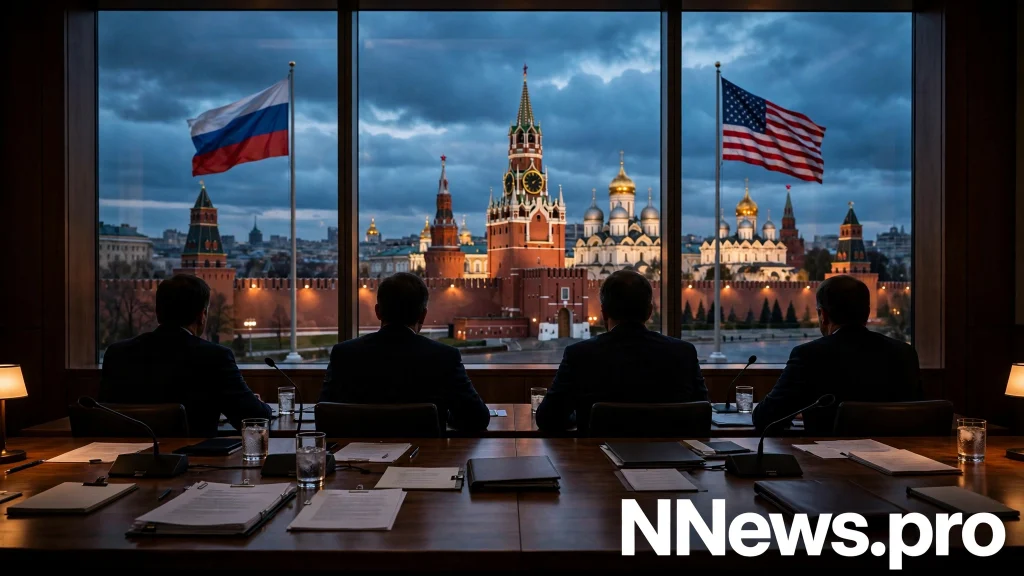
Russian President Vladimir Putin rejected any foreign peacekeeping force in Ukraine and refused to soften Moscow’s territorial demands after hours of talks in the Kremlin with US envoys Steve Witkoff and Jared Kushner on Thursday, November 12, a day that nonetheless produced a claim of progress: American and Ukrainian officials said European negotiators would join the next round of talks. The Kremlin did not confirm that claim.
The meeting in Moscow followed two days of US-mediated negotiations between Russian and Ukrainian delegations in the Abu Dhabi talks, the first three-way round in nine months. The envoys then flew to Dublin to brief Ukrainian President Volodymyr Zelenskyy, who said Europe would no longer be left on the sidelines.
Putin draws a hard line on troops and territory
Putin told the envoys that Moscow would not accept foreign troops in Ukraine after any peace agreement, calling such a deployment a “continuation of war” and warning that foreign forces would be treated as legitimate targets. He also said Russia would not soften its demands to control Ukrainian territory it claims to have annexed.
Moscow has formally annexed four Ukrainian regions — Donetsk, Kherson, Lugansk and Zaporizhzhia — although it does not control all of them. Kyiv and Western governments reject the annexations as illegal. Russia has held territory in eastern and southern Ukraine since launching its full-scale offensive in 2022, in addition to Crimea, which it annexed in 2014.
Putin also dismissed the idea of “grey”, or demilitarised, zones between Russian and Ukrainian positions. “For us, there is only one line of demarcation: the state border. Because then it will be clear and obvious: here are we, and here are you,” he said in an opening exchange with the envoys that the Kremlin televised.
The Kremlin session ran for hours. Agence France-Presse reported that the discussions lasted more than four hours, while other outlets put the meeting at about two and a half hours. It was Witkoff’s tenth meeting with Putin as Washington presses to broker an end to the war.
A disputed claim about Europe’s seat at the table
The most consequential claim to emerge from the day was also the most contested. Kushner said both sides had agreed to expand the next round of negotiations to include European partners. “We cannot conclude this deal without Europeans being at the table,” he said, adding that Putin was “willing to give it a try”.
Zelenskyy, after being briefed by the envoys in Dublin, said European representatives would take part in the next round rather than remain “separately” on the sidelines. “They will have a voice,” he said.
But the Kremlin did not confirm that Putin had agreed to include European representatives in future talks. Kremlin aide Yuri Ushakov gave no direct answer when asked whether Putin had backed a European role, and described the meeting only as useful, saying it had been agreed that the negotiating process would continue.
An EU official told AFP that representatives from five European capitals and the European Commission had also met the US envoys, and said a new multilateral meeting “will be fixed soon”. No date, venue or format for the next round has been announced, and it remains unclear who would represent Europe.
Kostyantynivka: a humanitarian proposal Kyiv distrusts
During the meeting, Putin proposed what he called a “humanitarian mission” to Kostyantynivka, a contested front-line city in the Donetsk region, saying 400 to 500 civilians remained there. He suggested a five-day operation, modelled on a short-term truce the previous month that allowed hundreds of stranded residents to leave Oleshky, a town in southern Ukraine under Russian occupation.
Kyiv reacted with caution. Dmytro Lytvyn, an adviser to Zelenskyy, warned that Russia could use a humanitarian operation to rotate new troops into the area, and Ukrainian officials said a similar move in Oleshky had been used to insert military assets. Kyiv demanded clarification of the proposal before agreeing to anything.
Russia claimed during the summer that it had captured Kostyantynivka, but Ukraine says fighting there is continuing.
A prisoner exchange, agreed in principle
The Abu Dhabi talks produced an agreement in principle on a large prisoner exchange, which Zelenskyy described as the largest of the war so far. The parameters of the exchange are still being agreed, according to Ushakov, and no final figure or date has been announced.
Witkoff struck an upbeat note as he left Moscow, telling CNN at Vnukovo Airport: “I think progress was made. I think it was made earlier today. People didn’t think that we were going to restart trilateral. We’ve restarted it. We’ve set a new meeting.”
Background: from Abu Dhabi to the Kremlin
The Moscow meeting capped a fast-moving week of diplomacy. The Abu Dhabi talks on November 10 and 11 were the first US-brokered three-way round since talks in Geneva on February 18. The US delegation was led by Witkoff and Kushner; Russia sent negotiator Vladimir Medinsky, while Ukraine was represented by Rustem Umerov.
Related Articles

Before the Moscow meeting, Russia had opposed including European representatives in the negotiations, and discussing Europe’s inclusion was a stated goal of the envoys’ trip. The push comes as the administration juggles parallel diplomacy in the Middle East, where Trump said the war with Iran was ‘effectively over’ earlier this week, even as a US naval blockade continues.
Ushakov said Putin would continue discussions on Ukraine with US President Donald Trump at an APEC summit in China later this month.
Why this matters
The day’s diplomacy exposed the central tension in the peace effort: the United States is trying to widen the table while Russia is holding its red lines. Bringing Europe into the talks would answer a long-standing demand from Kyiv and its allies, who have argued that the continent’s security cannot be settled over its head. But if Moscow has not actually agreed, the next round could begin with a dispute over who is even in the room.
Putin’s refusal to budge on territory and his warning that foreign troops would be legitimate targets also dampened hopes that the negotiations were bringing a peace agreement closer. The core dispute — control of land Russia claims but does not fully hold — remains unresolved, and the “grey zone” question shows the two sides are still far apart on even the basic shape of a settlement.
At the same time, the agreement in principle on a prisoner exchange and the restart of a trilateral format give the process something concrete to build on. For families of captured soldiers, a swap would be the most tangible result of the talks so far.
Latest developments
- Witkoff and Kushner briefed Zelenskyy in Dublin on November 13 after leaving Moscow. Zelenskyy said Europe would take part in the next round of talks.
- The Kremlin has not confirmed agreement on European participation. Ushakov said only that the negotiating track would continue and that another contact is expected before a planned Putin-Trump meeting in China.
- An EU official told AFP that representatives from five European capitals and the European Commission met the US envoys, and that a new multilateral meeting “will be fixed soon”.
- The parameters of the large prisoner exchange agreed in Abu Dhabi are still being negotiated, with no date or final number announced.
- Putin’s proposed five-day humanitarian mission to Kostyantynivka awaits clarification after Kyiv warned it could be used to move troops.
Frequently asked questions
What did Putin say about foreign troops in Ukraine?
Putin said Russia would not accept foreign peacekeeping troops in Ukraine after a peace agreement, calling such a deployment a “continuation of war” and warning that foreign forces would be treated as legitimate targets. He also rejected any softening of Moscow’s claim to four annexed Ukrainian regions.
Will Europe join the next round of Ukraine talks?
That is disputed. Kushner and Zelenskyy said both sides had agreed to include European negotiators in the next round, and an EU official said a new multilateral meeting “will be fixed soon”. But the Kremlin has not confirmed that Putin agreed, and his aide Yuri Ushakov gave no direct answer when asked.
What is the Kostyantynivka humanitarian proposal?
Putin proposed a five-day humanitarian mission to Kostyantynivka, a contested city in the Donetsk region where he said 400 to 500 civilians remain, modelled on a short-term truce last month in Oleshky. Kyiv warned the operation could be used to rotate Russian troops into the area and demanded clarification.
What happened to the prisoner exchange?
The Abu Dhabi talks produced an agreement in principle on a large prisoner exchange, which Zelenskyy described as the largest of the war so far. The final figures and date have not been announced, and the parameters are still being agreed.
The diplomacy now moves to the next test: whether a new round of talks can be scheduled, who sits at the table, and whether the prisoner exchange agreed in principle becomes a real swap. Until the Kremlin confirms Europe’s place in the process, the headline achievement of the Moscow trip remains a claim made by one side — and the hardest questions, over land and security, are untouched.
Sources
- Agence France-Presse via The Daily Flare — https://thedailyflare.com/europe/putin-rules-out-foreign-peacekeepers-as-ukraine-talks-move-toward-european-role/
- EuropeSays — https://www.europesays.com/europe/180650/
- The States Journal — https://thestatesjournal.com/articles/us-envoys-meet-putin-in-moscow-as-russia-us-agree-to-keep-talking-244b3838/
- VoceMundi — https://vocemundi.com/us-envoys-meet-putin-in-moscow-kushner-says-europeans-will-join-next-talks/
- Baltic Monitor — https://baltic-monitor.com/en/issues/2026-11-13/