Trump Says New Iran Strikes Are “Highly Unlikely” — but Talks Have Stalled and the Risk Remains
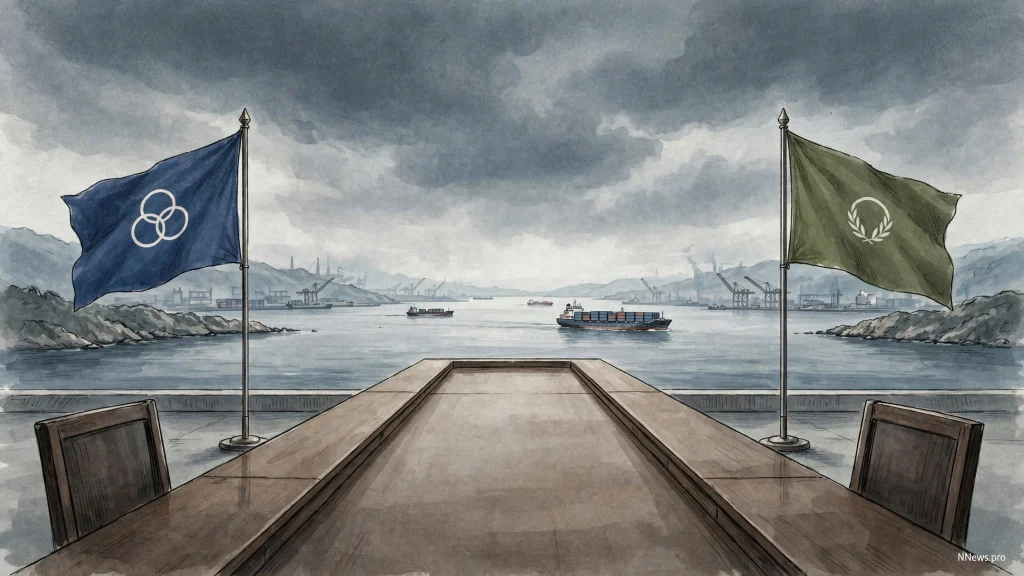
WASHINGTON — President Donald Trump said on Sunday, November 8, that he was “highly unlikely” to order fresh attacks on Iran as long as talks to end the conflict progress, even as both countries reported that shipping had been hit in or near the Strait of Hormuz.
“It depends on whether or not they sign a very strong agreement,” Trump told CNN in a phone interview. “The answer is, highly unlikely it’s going to be necessary.”
The statement was conditional, and the condition is far from met. Iran’s foreign minister said on the same day that mediators working for a peace deal had not travelled at all since the “shock” of the US midterm elections, in which Democrats won both chambers of Congress. The risk of a return to large-scale fighting has eased in Trump’s words, but it has not gone away.
A threat kept in reserve
Trump paired reassurance with a warning. He said the United States was ready to strike if necessary, adding: “We’re ready for it. I’ve got three aircraft carriers here. The other one just arrived. We have three. They’re fully locked and loaded.” He also said that if strikes resumed, the US had identified potential infrastructure targets, including 38 bridges “that we can knock down in literally one hour.” At the same time, he said he would prefer not to destroy Iranian infrastructure, because rebuilding it would take about ten years.
Trump further claimed that Iran retained only 10 percent of its missile capacity and 15 percent of its drone capabilities — his claim, not an independently verified assessment. He has acknowledged the war, begun by the US and Israel in late February, was at least partly responsible for the Republican defeat.
Talks paused, not broken
The diplomatic picture is stalled rather than collapsed. Iranian Foreign Minister Abbas Araghchi told state television: “For the past few days, there has been no more travel [by mediators], and the reason for this is the shock that the election results in the United States have caused to everyone.” He added: “We now have to see how long it will take for them to digest these results, in order to determine how we are going to move forward.”
Related Articles

Qatar, which has been mediating, denied reports on Saturday that the US and Iran had failed to reach a deal, and said both sides were continuing to work toward an agreement. Iran has submitted a nuclear proposal to Washington through Qatar, a senior Iranian official told Reuters, saying the US was reviewing it but that discussions would depend on Washington first meeting Tehran’s seven demands, including sanctions relief and access to frozen assets.
Shipping still under attack
On the water, the conflict has not paused. Both the US and Iran have continued strikes on vessels in the Strait of Hormuz, restricting exports of energy and other commodities vital to the world economy. Iran’s Revolutionary Guards said on Sunday that three oil tankers had caught fire after hitting mines while trying to pass through an unauthorised route in the strait. The US military said on Saturday evening that its air force had fired at the stern of a commercial vessel in the Gulf of Oman, disabling it as it tried to get through the blockade.
What could change
Three things will decide whether Trump’s “highly unlikely” holds: whether mediator travel resumes, whether shipping incidents escalate — a strike that kills crew or closes the waterway would change the calculation in both capitals — and whether either side treats the other’s conditions as a starting point or an ultimatum.
For now, the immediate danger of a new offensive appears lower than a week ago. But with talks paused, tankers burning and both sides still firing on shipping, that judgement rests on a single conditional sentence — and on talks that, by Iran’s own account, are not currently happening.








[…] Oil imports fell 13.3 percent from a year earlier in October, though shipments still reached their highest level since March as buyers sought supplies after the US-Israeli war on Iran disrupted flows in the Middle East. Trump says new US strikes on Iran are “highly unlikely” as talks stall […]
[…] For now, the market reaction has been muted. Oil prices fell sharply on Monday on hopes for diplomacy over Iran: Brent crude dropped 5.9 percent to $92.57 a barrel, while US West Texas Intermediate fell 4.4 percent to $86.85, according to AFP. President Donald Trump said on Monday that the United States was keeping the war with Iran at a “status quo” and that new American strikes were “highly unlikely,” easing immediate fears of escalation. Trump Says New Iran Strikes Are “Highly Unlikely” — but Talks Have Stalled and the Ris… […]
[…] Trump’s description of the war as effectively over, American forces have continued limited military operations. The United States carried out strikes on Iran, including against its air defenses, at least twice […]