Bukele’s Forces Retake Haiti’s Sylvio Cator Stadium From Gangs and Turn It Into a Military Base
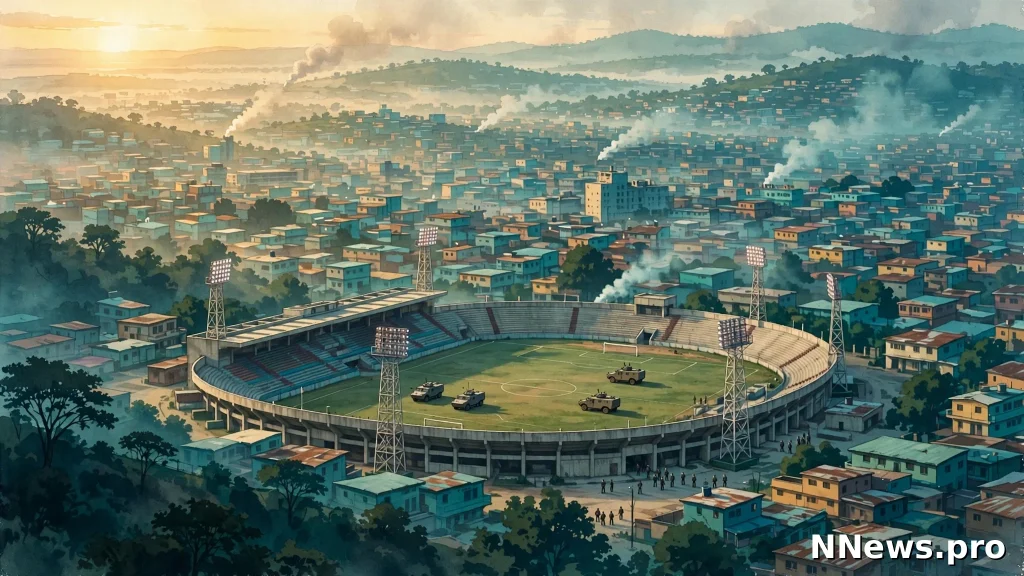
Haitian police and Salvadoran troops have retaken Sylvio Cator Stadium in Port-au-Prince, ending two years of gang control over Haiti’s national football ground, and El Salvador’s President Nayib Bukele says the venue will now serve as an operational base for a new offensive against the armed groups that dominate the capital.
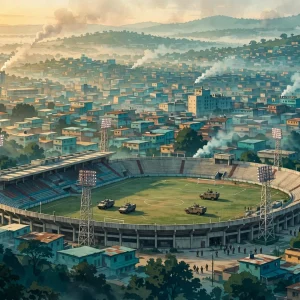
The operation took place early on Thursday, November 12, when the Haitian National Police, supported by a government-backed Task Force, moved into the stadium and surrounding areas. Police said they had regained “full control” of the site before handing responsibility for securing it to Salvadoran soldiers, who took up positions inside the complex with armored vehicles. Photographers from the AFP news agency documented Salvadoran troops and military vehicles inside the previously gang-held venue.
In a post on X written in Haitian Creole on Friday, Bukele announced the stadium would be used as a base from which security forces would push into gang-held neighborhoods. He urged gang members to leave the area before the next phase of the offensive begins, warning that those who stayed to fight would face consequences. Bukele also said several human skulls were found inside the stadium during the operation. That claim has not been independently verified.
A landmark held by gangs since 2024
Sylvio Cator Stadium, which opened in 1953 and holds about 10,000 spectators, is Haiti’s principal football venue and the home ground of the national team. Armed groups seized it in 2024 as gangs expanded their control across Port-au-Prince, and the deteriorating security situation forced Haiti to play its home fixtures abroad during the 2026 World Cup qualifying campaign, including matches in Curacao.
Haiti nevertheless qualified for the 2026 World Cup, its second appearance at the tournament. The stadium’s recovery is therefore symbolically important for Haitian football, although no date has been announced for the resumption of matches there. With Salvadoran forces expected to use the venue as a military base, a return to football is not an immediate prospect: the site first has to be assessed, made safe and separated from military operations.
The police statement on the operation did not provide a casualty count, details of arrests or information about weapons seized. More than 20 armored vehicles and trucks were reported at the site, according to Haitian reporting.
Bukele’s expanding Haiti operation
The stadium operation is the latest and one of the most visible gains in Bukele’s rapidly expanding military campaign in Haiti. El Salvador has deployed a contingent of roughly 2,000 troops to the country under a bilateral security agreement with Haiti’s government, operating alongside the Haitian National Police, the Haitian Armed Forces and the government Task Force.
The deployment followed an ambush on October 18 in which four Salvadoran military personnel went missing in Port-au-Prince. The Salvadoran forces operate separately from the United Nations-backed Gang Suppression Force, whose mandate and operations are distinct from the Salvadoran mission. The United Nations has said most Salvadoran personnel are operating outside the UN-backed framework, raising questions about coordination, command and accountability.
Earlier in the week, Bukele said Salvadoran forces had destroyed what he described as the headquarters of 400 Mawozo, one of Haiti’s most powerful armed groups, in an air assault near Port-au-Prince. The operation targeted strongholds belonging to the gang and the home of its leader, Lanmo San Jou. As many as 20 people are believed to have been killed, according to the Miami Herald, citing anonymous sources. The Haitian prime minister, Alix Didier Fils-Aime, thanked Bukele and praised the forces confronting the gangs.
EFE reported that the Task Force working with Haitian police is led by U.S. businessman Erik Prince. Salvadoran state television confirmed that its soldiers had taken positions at the stadium.
Why this matters
The stadium sits near the Bicentenaire, Portail-Leogane and Martissant districts, close to areas long threatened by gangs, so holding it gives security forces a foothold in central Port-au-Prince. Its loss to gangs in 2024 had demonstrated how far armed groups had penetrated the capital; retaking it shows that security forces can recover important sites when they coordinate resources and maintain pressure.
Related Articles
Trump Says Gulf Allies Asked Him to Hold Off Iran Strikes, Claims He Could “End It” in Three Days

Kushner Says Europe Will Join Next Round of Russia-Ukraine Talks as US Works Toward Largest Prisoner Exchange of the War

US Handled $12.26 Billion in Venezuelan Oil Revenue in 2026, State Department Report Reveals
For the United States, the operation matters because Haiti’s collapse has direct consequences for the region. Gang violence has driven displacement and migration, and Washington has watched closely as Bukele exports the hardline anti-gang model he used at home — mass detention, a state of exception and a mega-prison — to a foreign country. Human-rights organizations have raised concerns about mass detention, due process and alleged abuses under that approach in El Salvador, and the same questions now follow the Haiti deployment.
The stakes are underscored by the scale of the violence. The United Nations Integrated Office in Haiti reported on November 11 that at least 1,167 people were killed and 459 injured between July 1 and September 30, 2026. The report said gang members were responsible for more than 45 percent of those killed or injured, while more than half of documented casualties occurred during security-force operations against gangs. It also warned that more than 16 percent of people affected during security operations were not associated with gangs — a reminder that restoring state control must also protect civilians and comply with international human-rights standards.
Haiti’s crisis has also reached American shores in other ways: an 8-year-old Haitian boy was taken into federal custody at an immigration check-in in San Diego this month, and President Donald Trump recently threatened to double tariffs on Mexico if it does not stop a migrant caravan heading north.
Latest developments
Bukele’s warning that gang members should leave the area before the offensive begins suggests further operations around the stadium are imminent, although authorities have not publicly provided details about the timing or scope of the next operation. The situation remains fluid, and there has been no independent confirmation of the reported human remains.
For residents near the stadium, the immediate question is whether the new security presence will prevent armed groups from returning and allow daily life to resume. Retaking a building is only one step. Sustained control requires reliable policing, functioning courts, public services, safe transport routes and protection for the people living in the surrounding neighborhoods.
Frequently Asked Questions
Why is the Sylvio Cator Stadium important?
It is Haiti’s national football stadium and a major public landmark in central Port-au-Prince. Gangs seized it in 2024, and its recovery is both a symbolic and a practical gain for Haitian authorities, giving security forces a foothold near gang-controlled districts.
Who retook the stadium?
The Haitian National Police, supported by a government-backed Task Force, carried out the operation early on Thursday, November 12. Control was then handed to Salvadoran soldiers, who are guarding the complex and will use it as an operational base.
What did Bukele say about the operation?
In a post on X written in Haitian Creole, Bukele said the stadium would become a base for further operations against gangs and warned gang members to leave the area before the offensive begins. He also said several human skulls were found inside the stadium, a claim that has not been independently verified.
Will football return to the stadium soon?
No date has been announced. With Salvadoran forces using the venue as a military base, the site must first be assessed, made safe and separated from military operations before matches can realistically be considered.
The retaking of Sylvio Cator Stadium is a visible gain for Haiti’s security forces, but it is a security foothold rather than a restoration of public life. Whether the surrounding neighborhoods become safer, residents can move freely, and the state can provide services without relying indefinitely on armed deployments will be the real test of the operation.
Sources: EFE; AFP; Haitian National Police; Associated Press; United Nations Integrated Office in Haiti; Miami Herald.