Trump’s Board of Peace Calls Gaza Flooding an “Immediate Humanitarian Emergency”
Trump’s Board of Peace Calls Gaza Flooding an “Immediate Humanitarian Emergency”
President Donald Trump’s Board of Peace warned on Monday that severe flooding in Gaza has become an “immediate humanitarian emergency,” urging Israel to let winter supplies into the territory at once after days of heavy rain swamped tens of thousands of displacement tents and killed at least five people.
The rebuke carries unusual weight because it comes from the body Trump himself created to oversee the October 2025 US-brokered ceasefire between Israel and Hamas. The United Nations backed the board’s assessment on Monday, and Hamas pushed back on Tuesday, saying the statement understated Israel’s role in stalling the peace plan.
A storm that overwhelmed the camps
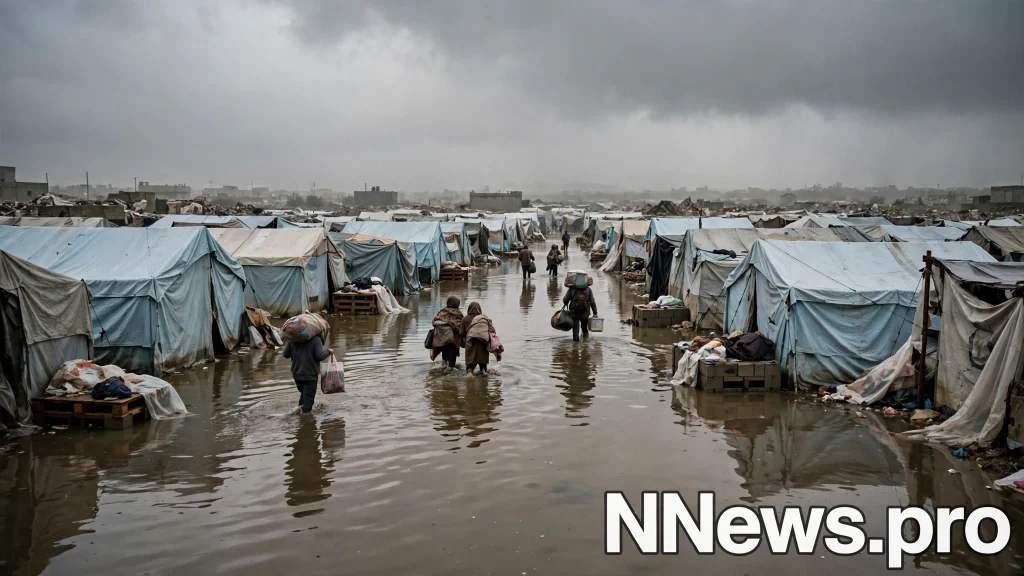
A powerful storm struck Gaza on Friday evening, November 6, and the rain continued through the weekend. According to the territory’s Government Media Office, more than 70,000 tents were flooded within about 12 hours, affecting an estimated 350,000 people, including roughly 210,000 children. The UN humanitarian office, OCHA, said heavy rain and strong winds flooded displacement camps in all five of Gaza’s governorates, leaving thousands of families without shelter or belongings.
At least five people have been killed in the flooding, according to figures cited by Agence France-Presse from Hamas-led authorities in Gaza. Gaza’s Civil Defense said two women and three children, aged eight, six and four, were killed late on Sunday night when a sand embankment weakened by the rain collapsed onto tents in a displacement camp south of Deir al-Balah. Dozens of walls already damaged in the war also collapsed, the Government Media Office said.
More than one million people in Gaza are still living in tents and damaged buildings, aid agencies say, and winter has only just begun.
What the Board of Peace said
In a statement issued on Monday, November 9, the Board of Peace said the flooding had inundated tens of thousands of tents and makeshift shelters, damaging essential belongings and leaving displaced families exposed to cold weather and unsafe shelter.
“The situation no longer represents simply a threat posed by the approaching winter, but an immediate humanitarian emergency,” the board said.
The board said it had been warning Israel, which controls all entry into Gaza, of the need to prepare for winter and for seasonal flooding. It called on “the leadership of the current Government of Israel to act immediately to authorise and facilitate the entry of all necessary winterisation and humanitarian supplies.”
Specifically, the board urged Israel to authorize essential materials for temporary shelter, water and sanitation infrastructure, waste management, drainage and sewage removal, and to meet its commitments under the Sharm El-Sheikh Humanitarian Protocol. It acknowledged steps Israel has taken but said the response remained “insufficient.”
The board also directed demands at Hamas. It called on the group to lay down its arms, relinquish governing authority and fulfil its obligations under the peace plan, saying continued military activity by Hamas in civilian areas and near Israeli positions endangered civilians and undermined humanitarian progress.
Finally, the board urged the United Nations, its agencies and international donors to coordinate with it to mobilize resources, supplies and operational support for Gaza’s immediate winterization needs, saying the assistance was essential to preserving humanitarian gains and accelerating Gaza’s transition toward recovery and functioning civilian institutions under the National Committee for the Administration of Gaza.
The United Nations agrees
The United Nations backed the board’s assessment on Monday. UN deputy spokesperson Farhan Haq told reporters that the world body agreed with the board’s assessment and urged Israel to allow more shelter materials and equipment into the territory. OCHA said in an update on Monday that thousands of families had lost their shelters and belongings as rain and strong winds hit Gaza over the weekend.
Israel’s response: supplies are flowing, requests are stalled
Shortly before the board’s statement was issued, the Israeli military said it had allowed more than 8,200 trucks carrying supplies into Gaza, including about 90,000 tents. Israel’s military liaison body, COGAT, said more than 90,000 tents and 8,200 trucks carrying tarps, blankets, winter clothing and other supplies had entered the territory.
COGAT added, however, that half of the requests for winter-specific supplies remained stalled, blaming logistical and budgetary challenges by the United Nations and aid groups. The board’s position was that the response, whatever its scale, remained insufficient for the scale of the flooding.
Related Articles


Hamas pushes back
Hamas pushed back against the board’s account on Monday, according to Turkey’s state-run Anadolu news agency. The group said it noted the board’s criticism of Israel but argued that the statement did not address Israel’s wider role in blocking Trump’s plan, and it rejected attempts to hold the Palestinian resistance responsible for delays in implementing the roadmap, saying it and other Palestinian factions had already accepted the agreed terms.
Hamas cited an August 3 statement by mediators Egypt, Qatar and Türkiye, which warned that Israeli violations were eroding the plan’s second phase. The group argued that using lifesaving aid as political leverage breached humanitarian and legal obligations, while shelter supplies remained outside Gaza as displaced families faced flooding and cold. It demanded the immediate and unconditional opening of crossings to allow the entry of humanitarian aid, shelter materials and reconstruction supplies.
Why this matters
The flooding is the first major test of the ceasefire framework since it took effect in October 2025. The Board of Peace was created to implement that agreement, and its first public rebuke of Israel — backed by the United Nations — puts fresh pressure on both sides to let winter supplies in before the next storm hits.
For the more than one million people still living in tents and damaged buildings, the stakes are immediate. Aid agencies warn that the worst of winter may still be ahead, and that tents flooded once can flood again with the next storm. The board warned that continued delays in turning commitments into action could further undermine the prospects for lasting peace.
The episode also exposes the central tension in the ceasefire’s implementation: Israel says it has allowed tens of thousands of tents and thousands of trucks into Gaza, while the board, the UN and Hamas all say — for different reasons — that what has arrived is not enough, and not fast enough.
Latest developments
- The Board of Peace issued its statement on Monday, November 9, calling the flooding an “immediate humanitarian emergency.”
- The United Nations said on Monday that it agreed with the board’s assessment.
- Hamas responded on Monday, welcoming the board’s acknowledgment of Israeli obstruction but saying the statement presented an incomplete picture.
- COGAT said more than 8,200 trucks and about 90,000 tents had entered Gaza, but that half of winter-specific supply requests remained stalled.
- Aid agencies warn that further storms are expected as winter sets in, with more than one million people still in tents and damaged buildings.
Frequently asked questions
What is the Board of Peace?
The Board of Peace is the body created by President Donald Trump to oversee implementation of the October 2025 US-brokered ceasefire between Israel and Hamas. It is charged with monitoring the parties’ commitments, including humanitarian access, and coordinating Gaza’s transition toward recovery and functioning civilian institutions.
How bad is the flooding in Gaza?
According to Gaza’s Government Media Office, a storm that began on Friday evening flooded more than 70,000 tents, affecting an estimated 350,000 people, including about 210,000 children. The UN humanitarian office said displacement camps in all five of Gaza’s governorates were flooded. At least five people were killed, according to figures cited by AFP.
What is the board asking Israel to do?
The board called on Israel to act immediately to authorize and facilitate the entry of all necessary winterization and humanitarian supplies, including materials for temporary shelter, water and sanitation infrastructure, waste management, drainage and sewage removal, and to meet its commitments under the Sharm El-Sheikh Humanitarian Protocol.
What is the board asking Hamas to do?
The board called on Hamas to lay down its arms, relinquish governing authority and fulfil its obligations under the peace plan. Hamas rejected blame for delays in the roadmap, saying it and other Palestinian factions had already accepted the agreed terms, and argued the board’s statement understated Israel’s role in stalling the plan.
What to watch next
The immediate question is whether winter supplies move faster in the coming days. The board has called for “immediate and measurable action” from all parties, and the UN has urged Israel to allow more shelter materials and equipment in. With winter only beginning and more than a million people still sheltering in tents, the next storm — not the last one — is the deadline that matters.
Sources: Board of Peace statement as reported by Anadolu and R24 News; Agence France-Presse via Al-Monitor; United Nations OCHA and UN spokesperson Farhan Haq; COGAT; Hamas statement as reported by Anadolu and Press TV.