ULA’s Vulcan Returns to Flight, Launching 40 Amazon Leo Satellites After Nine-Month Grounding
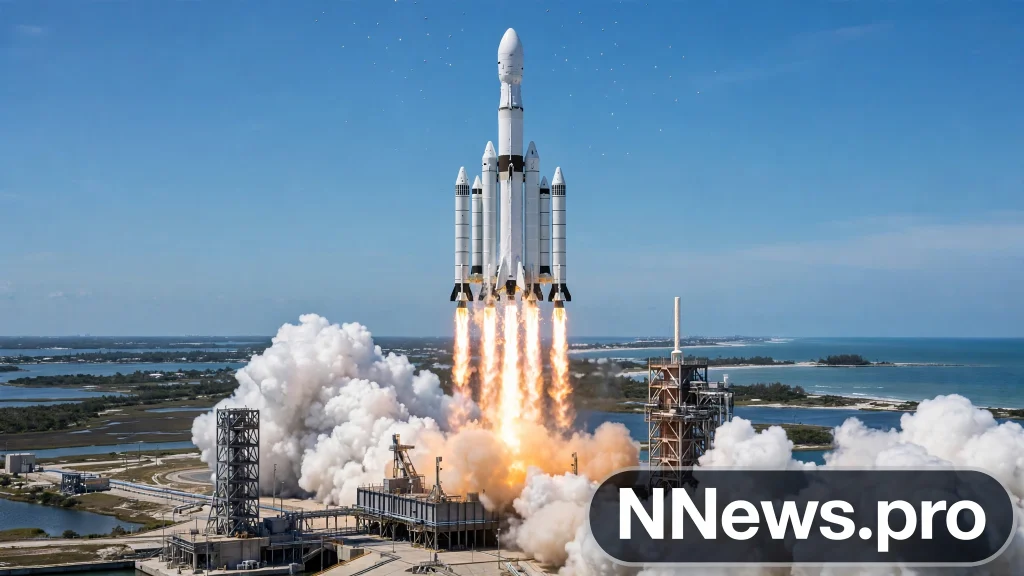
United Launch Alliance’s Vulcan rocket returned to flight on Sunday, lifting off from Cape Canaveral with 40 Amazon Leo broadband satellites aboard and ending a nine-month grounding caused by solid rocket booster nozzle failures.
The rocket lifted off from Space Launch Complex 41 at Cape Canaveral Space Force Station in Florida at 12:40 p.m. EST, ULA confirmed in a video of the liftoff posted shortly afterward. The mission, designated Amazon Leo LV-01, is the first of 38 Vulcan launches Amazon has booked to build out its satellite internet constellation, formerly known as Project Kuiper.
A comeback flight watched closely
The flight was the fifth ever for Vulcan and the first in its most powerful configuration, known as VC6L, with six side-mounted solid rocket boosters. It was also the first flight of a redesigned booster nozzle — the part that failed on two of Vulcan’s first four missions.
Vulcan last flew on February 12, 2026, on the USSF-87 national security mission, when one of its boosters appeared to suffer a nozzle burn-through about 20 seconds after liftoff. An earlier nozzle failure occurred during the rocket’s second flight in October 2024. After the February failure, the U.S. Space Force paused national security launches on Vulcan, and the rocket had not flown since.
ULA chief executive Tory Bruno has said the Space Force wants to review data from this flight before deciding whether Vulcan resumes flying military missions. A clean flight would not automatically close that decision, but it is the first real-world test of whether the redesigned nozzle holds when all six motors burn at once.
Two scrubs before Sunday’s liftoff
Getting to the pad took three attempts. ULA scrubbed the first try on Friday, November 13, at 8:41 a.m. EST, after a power interruption at an Air Liquide gaseous nitrogen plant cut power to the facility’s high-pressure pumps. The team turned the mission around in a single day, only for a network communication issue between the ground and the rocket to push the second attempt from Saturday to Sunday.
Sunday’s countdown targeted 12:11 p.m. EST, then slipped to 12:40:30 p.m. after an automated check detected a reading outside its allowed limit. ULA reported the hold issue cleared at 12:26 p.m., and the rocket lifted off at the end of the window.
The 65-meter-tall rocket, powered by two Blue Origin BE-4 engines and six Northrop Grumman GEM-63XL solid rocket boosters, generates about 17.2 meganewtons of thrust and can lift up to 27,200 kilograms to low Earth orbit. It flew on a northeasterly trajectory from the Florida coast.
What happens next in orbit
The 40 satellites are the largest batch Amazon has launched at once. They are scheduled to be released into a 450-kilometer circular parking orbit inclined 51.9 degrees to the equator in 21 separate deployment events, with the first about one hour and 17 minutes after liftoff and the sequence lasting about 25 minutes and 40 seconds.
Once deployed, the Amazon Leo constellation will have 432 satellites in orbit. As of early November, 368 satellites were in their operational orbit, with six having reentered Earth’s atmosphere. Amazon needs 578 satellites deployed to begin initial regional service, and the first-generation network is planned to use up to 3,236 satellites.
The mission also marks the first flight of a shorter, low-Earth-orbit-optimized version of Vulcan’s Centaur V upper stage, which doubles as a certification flight for the configuration for the U.S. Space Force. It is the first Vulcan mission processed at Amazon’s new Vertical Integration Facility at Cape Canaveral.
Related Articles

Why this matters
Vulcan is ULA’s next-generation heavy-lift rocket, built to replace the Atlas V and Delta IV families and to carry both commercial payloads and U.S. national security missions. A nine-month grounding left a gap in that plan, and Amazon is counting on Vulcan for close to half of its first-generation constellation — making the rocket’s reliability central to the company’s race against SpaceX’s Starlink, which already operates thousands of satellites.
For ULA, a successful return to flight restores momentum after a year defined by the nozzle problem. For Amazon, each Vulcan launch moves its broadband network closer to the scale needed to start serving customers, after the Federal Communications Commission granted the company an extension in June 2026 of its deadline to deploy half of the constellation.
Latest developments
- Liftoff occurred at 12:40 p.m. EST on Sunday, November 15, 2026, from Space Launch Complex 41 at Cape Canaveral.
- Satellite deployment is scheduled to begin about 1:57 p.m. EST, with 21 deployment events spread over roughly 26 minutes.
- The Space Force will review flight data before deciding whether Vulcan resumes national security missions.
- Amazon has 37 more Vulcan launches contracted after LV-01, plus eight successful deployment missions already flown on Atlas V.
Frequently Asked Questions
How many satellites did the Vulcan launch carry?
The rocket carried 40 Amazon Leo broadband satellites, the largest batch Amazon has launched on a single mission. It was the first of 38 Vulcan launches Amazon has contracted with ULA.
Why was Vulcan grounded for nine months?
A solid rocket booster nozzle failed during the USSF-87 mission on February 12, 2026, about 20 seconds after liftoff. It was the second nozzle failure in Vulcan’s first four flights, after a similar problem in October 2024. The Space Force paused national security launches on Vulcan while ULA redesigned the nozzle.
What is Amazon Leo?
Amazon Leo, formerly known as Project Kuiper, is Amazon’s satellite internet constellation in low Earth orbit, managed by Amazon subsidiary Kuiper Systems. The first-generation network is planned to use up to 3,236 satellites to provide broadband internet access, competing with SpaceX’s Starlink.
When will the satellites be deployed?
Deployment into a 450-kilometer orbit is scheduled in 21 separate events, beginning about one hour and 17 minutes after liftoff and lasting about 25 minutes and 40 seconds. Once deployed, the constellation will total 432 satellites.
ULA’s Vulcan is back in the air, and its most closely watched test — the redesigned booster nozzle under full load — is now in the flight data. The Space Force’s review of that data will decide how quickly the rocket returns to its national security role, while Amazon’s constellation buildout continues with 37 more Vulcan flights on the books.
Related reading: Rocket Lab flies its 100th Electron rocket | SpaceX catches Starship Ship 42 at the tower
Sources: ULA; NASASpaceflight; Spaceflight Now; Amazon; Tech Times