SpaceX Catches Starship Ship 42 at the Tower in a First for Orbital Rocket Recovery
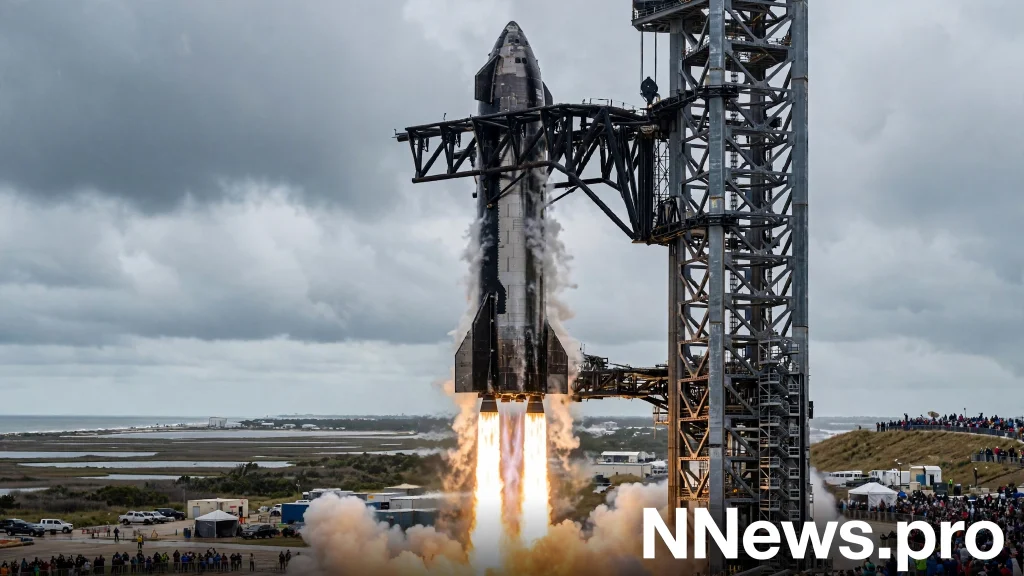
SpaceX caught its Starship upper stage, Ship 42, with the mechanical arms of its launch tower at Starbase, Texas, on Saturday afternoon, completing the first-ever recovery of an orbital upper stage at a launch site. The catch came about 22 and a half hours after the giant rocket lifted off on Friday, closing out a flight that had already lost its booster to an aborted catch attempt.
The black stainless-steel ship descended through overcast skies under engine power, flipped to vertical, and settled between the tower’s “chopstick” arms at about 4:20 p.m. Eastern, roughly 22 hours and 32 minutes after launch. Video from the return showed the vehicle hanging suspended in the arms as vapor vented from the tower and crowds of spectators cheered. NASASpaceflight, which streamed the attempt live, confirmed the moment with the words: “Ship 42 is back too.”
A first no rocket has achieved before
SpaceX has caught Super Heavy boosters three times before, but never the ship itself. Until Saturday, no upper stage that had flown to orbit had ever been caught in midair and returned to its launch site. The maneuver is the missing half of SpaceX’s plan for a fully reusable Starship: both stages flying back to the same tower, ready to be stacked and flown again.
The attempt was the most demanding part of Flight 15. After separating from its booster on Friday, Ship 42 climbed to an orbit about 275 kilometers (170 miles) above Earth — only the second time a Starship has reached orbit — and deployed all 26 of its Starlink V3 satellites, the first full operational Starlink load the vehicle has ever carried. Three of the satellites carried cameras to photograph the ship’s heat shield after separation, and SpaceX spokesperson Dan Huot said engineers assessed the thermal protection as healthy for the return.
The ship then spent about 22 hours circling Earth, completing roughly 14 orbits while flight controllers worked through three go/no-go checkpoints. The final decision to attempt the catch came about two hours before the return. If any check had failed, the ship would have been diverted to a pre-cleared splashdown zone in the ocean instead. SpaceX chief executive Elon Musk had called the odds of a successful catch “more likely than not” before the flight.
Half of the double catch was lost on Friday
The mission had aimed even higher. Flight 15 was the first attempt to recover both stages of a single rocket on the same flight. That plan ended minutes after liftoff on Friday, when the Super Heavy booster, Booster 22, aborted its own return to the tower.
According to Huot, the booster initially received permission to be caught, but its onboard automation detected a problem in its guidance, navigation and control system during the return and diverted the vehicle to a contingency splashdown site in the Gulf of Mexico. The booster exploded just above the water about six and a half minutes after launch. It was the first catch attempt for the upgraded Version 3 Super Heavy, and SpaceX has not yet given a fuller explanation of what went wrong.
Related Articles



Why this matters
A reusable upper stage changes the economics of the Starship program. The ship is the part of the vehicle that carries cargo, crew and satellites — and until now, every orbital upper stage in history has been thrown away after a single flight. Bringing Ship 42 back intact means SpaceX can inspect a flown heat shield, flown engines and flown structure, and learn how close the design is to flying again without a rebuild.
The result also matters beyond SpaceX. NASA has chosen Starship as the lander for its Artemis program to return astronauts to the Moon, and the company’s Starlink expansion depends on the ship’s ability to carry full loads of its larger V3 satellites. Rapid reuse of both stages is what makes the system affordable enough for those plans — and for Musk’s longer-term goal of sending Starships to Mars.
What happens next
SpaceX has not yet said how quickly Ship 42 will be inspected or whether any part of it will fly again. Engineers will now examine the heat shield, the six Raptor engines and the catch fittings that took the vehicle’s weight in the tower arms. The company will also keep investigating why Booster 22’s guidance system triggered the abort, since the next flight will need both stages to come home for the full double catch to be demonstrated.
For now, Flight 15 ends as a split result: a booster lost to the Gulf, and a ship that made history by coming home.
Frequently Asked Questions
Has SpaceX ever caught a Starship upper stage before?
No. Saturday’s catch of Ship 42 was the first time an orbital upper stage has been caught by a launch tower. SpaceX had previously caught three Super Heavy boosters, most recently in March 2025, but the ship had never been recovered.
What happened to the booster on Flight 15?
Booster 22’s onboard automation detected a guidance, navigation and control problem during its return and aborted the tower catch. The booster was diverted to the Gulf of Mexico, where it exploded just above the water about six and a half minutes after liftoff.
How long was Ship 42 in space?
About 22 and a half hours. It launched on Friday at 5:47 p.m. Eastern, reached an orbit about 275 kilometers high, deployed 26 Starlink V3 satellites, completed roughly 14 orbits, and was caught at Starbase at about 4:20 p.m. Eastern on Saturday.
Why is catching the ship important?
The ship carries cargo, crew and satellites, and until now every orbital upper stage has been discarded after one flight. Recovering it intact lets SpaceX reuse the most expensive part of the vehicle and inspect how its heat shield and engines survived reentry — a key step toward rapid, low-cost reuse for Moon and Mars missions.
Sources: NASASpaceflight; SpaceX & Space News; drohnen.de; Starlust; AsiaToday; Associated Press