Voyager 1 Closes In on One Light-Day From Earth, a First for Any Human-Made Object
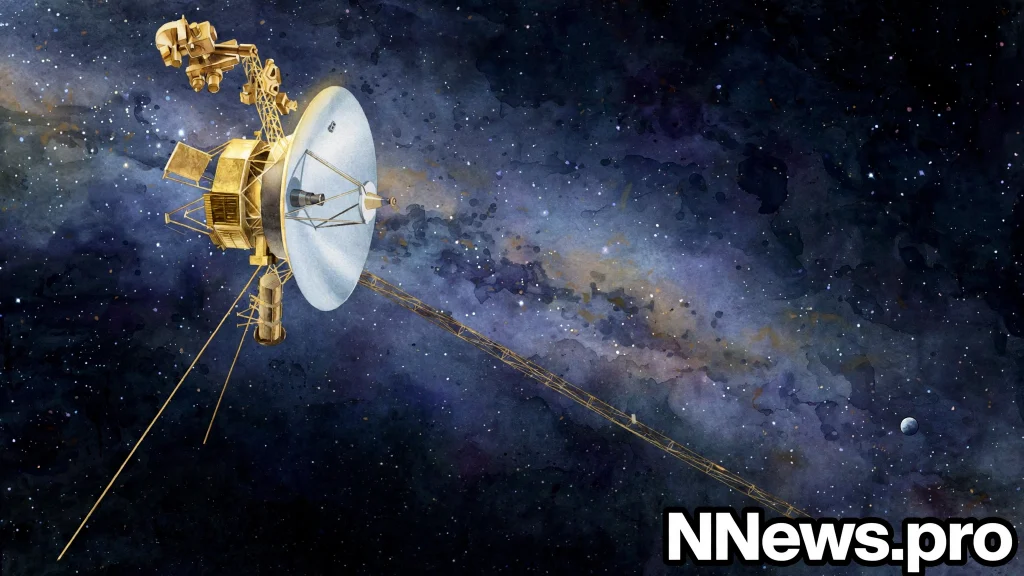
NASA’s Voyager 1 spacecraft is about to set a distance record no human-made object has ever reached. On Wednesday, November 18, 2026, at 5:16 a.m. EST, the 49-year-old probe will sit one full light-day from Earth — more than 16 billion miles away — with its radio signals taking an entire day to make the trip home.
A light-day is the distance light travels in 24 hours: about 16.09 billion miles (25.9 billion kilometers), or roughly 173 times the average distance between Earth and the Sun. Once Voyager 1 crosses that line, a command sent from mission control in California on Wednesday morning will not arrive until Thursday, and the reply will not turn up until Friday.
A journey of nearly half a century
Voyager 1 launched from Cape Canaveral, Florida, on September 5, 1977, sixteen days after its twin, Voyager 2. Built to study the outer planets, it flew past Jupiter in March 1979 and Saturn in November 1980, then kept going. In February 1990, from beyond Neptune, it turned its camera back toward home and took the most distant photograph of Earth ever made — the famous “Pale Blue Dot.” In August 2012, it became the first spacecraft to cross the heliopause and enter interstellar space, the region between star systems.
It has been the most distant human-made object since February 17, 1998, when it overtook Pioneer 10. Voyager 2, which took a slower path past Uranus and Neptune, is about 2 billion miles closer to Earth and will not reach the one-light-day mark until 2035.
Why this milestone matters
The crossing is a measure of endurance as much as distance. Voyager 1 is traveling at about 38,000 miles per hour, yet at that speed it would still take roughly 18,000 years to cover a single light-year. In about 40,000 years, it is expected to drift within about 1.6 light-years of the star Gliese 445 — the closest it will come to another star for a very long time.
NASA has kept the aging spacecraft alive through careful power management. Engineers carried out a major power-saving operation known as the “Big Bang” in September 2026, and the team briefly lost contact with the probe in October before restoring it on October 20. NASA hopes the surviving scientific instruments can keep collecting data from interstellar space until around 2036.
Voyager 1 project manager Suzanne Dodd told The Associated Press she sees the spacecraft as Earth’s ambassador hurtling between the stars, providing a “sense of wonder” back home.
A wave from Earth
To mark the occasion, NASA is inviting people around the world to take part in an event it calls “Shine Bright for Voyager’s Light-Day”: step outside after sunset on Tuesday, November 17, and shine a light toward the sky as a greeting to the distant spacecraft.
Related Articles



The milestone comes as spaceflight keeps making headlines closer to home: SpaceX’s Starship Flight 15 reached orbit on Friday, and SpaceX’s $24 billion gas plant and super-computer hub in Texas is also in the works. But no rocket launched in the modern era has gone, or will soon go, as far as the probe that left Earth in 1977.
Scientists stress that the one-light-day line is not a physical boundary. Voyager 1 will not slow down, change direction, or encounter anything new as it crosses it. It will simply keep traveling, much as it did the day before — only farther from home than anything humanity has ever built.
Frequently asked questions
What is a light-day?
A light-day is a unit of distance, not time: the distance light travels in a vacuum over 24 hours. That works out to about 16.09 billion miles (25.9 billion kilometers), or about 173 astronomical units — the average Earth-Sun distance.
When exactly does Voyager 1 reach one light-day from Earth?
NASA puts the crossing at 5:16:07 a.m. EST (10:16:07 UTC) on Wednesday, November 18, 2026. At that moment, Voyager 1 will be 16,094,799,096 miles from Earth.
How long do radio signals take to reach Voyager 1?
A full day. Once the probe is one light-day away, a signal traveling at the speed of light needs 24 hours to reach it, so a question from mission control and the spacecraft’s reply take roughly 48 hours for a complete round trip.
Will Voyager 1 ever reach another star?
Not in any meaningful timeframe. It is heading toward the star Gliese 445 but will only pass within about 1.6 light-years of it in roughly 40,000 years. NASA estimates it would take about 18,000 years to travel a single light-year at its current speed.
Voyager 1’s next landmark is its 50th launch anniversary in September 2027. Until then, the probe will keep sending back measurements from a region no spacecraft has visited before — one radio signal, one day at a time.
Sources: AP via TMJ4/Scripps News Group; NASA Science — Voyager 1; The Register