North Korea Changes Its Flag for the First Time Since 1948 as Revised Constitution Drops Reunification
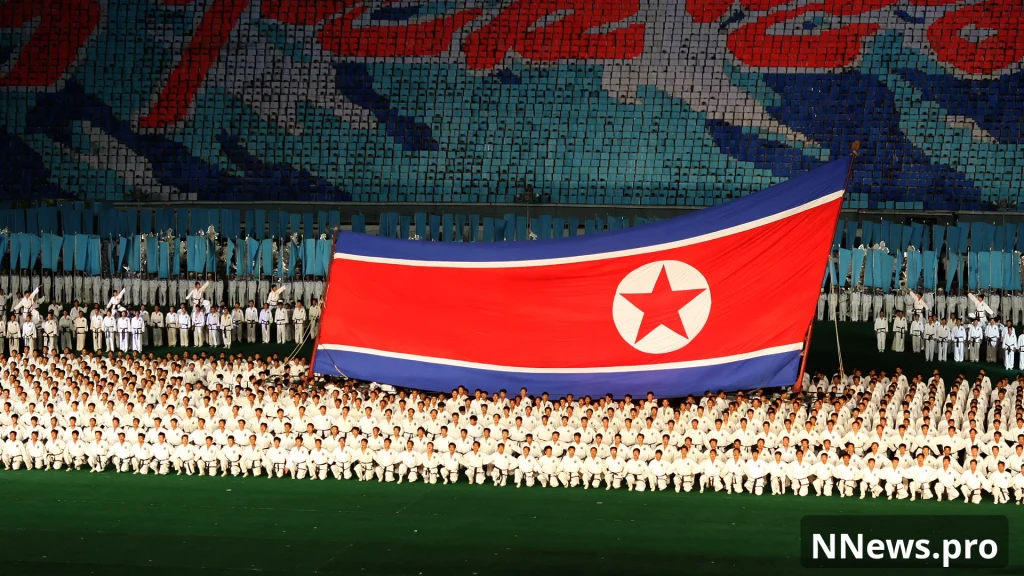
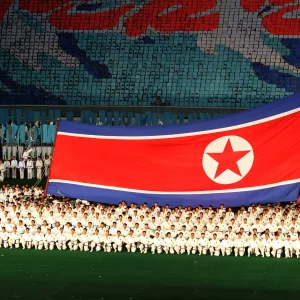
North Korea has changed the official proportions of its national flag for the first time since the country was founded in 1948, as a newly published revised constitution formally drops the goal of Korean reunification and names South Korea as a separate neighboring state.
The revised constitution was released in full on Naenara, North Korea’s external propaganda website, on Wednesday, November 11. Its text had been inaccessible online for more than two and a half years, after Naenara disabled its constitutional section in March 2024. The document carries a note saying it was amended and supplemented on March 23, 2026, at the first session of the 15th Supreme People’s Assembly, the country’s legislature.
The flag change is set out in Article 166 of the revised constitution. It fixes the ratio of the flag’s height to its width at 1 to 1.65, replacing the longstanding 1 to 2 specification. At the same height, the new flag is 17.5 percent narrower than the old one. A flag 100 centimeters tall would now be 165 centimeters wide, rather than 200.
What changed — and what did not
The flag’s familiar design is unchanged. A broad red band runs across the middle, with narrow white bands immediately above and below it and blue bands along the upper and lower edges. A red five-pointed star sits inside a white circle near the flagpole. Images on Naenara also appear to show thicker white stripes, roughly one third the thickness of the blue bands, although the constitutional wording still describes the white bands as narrow and gives no new measurement for them.
North Korean authorities have not publicly explained why they chose the new proportions. The change had already been visible before the constitutional text became public: a photograph issued by the state Korean Central News Agency on September 7 showed a flag with the revised proportions at the launch of the naval destroyer Kang Kon.
The flag itself has a complicated history. It was introduced in 1948 under founding leader Kim Il Sung, Kim Jong Un’s grandfather, from a design developed in Moscow and presented by Soviet officials. Before the division of Korea produced separate national flags, Koreans in both the north and south had used the Taegeukgi, whose central red and blue symbol remains part of South Korea’s flag today.
The flag’s long shape was debated from the start. During parliamentary discussions in 1948, a proposal to shorten it was rejected, with senior assembly figure Kim Du Bong opposing proportions different from 1 to 2. North Korean accounts later credited Kim Il Sung with the flag’s creation, giving less attention to its Soviet origins, and after the country adopted its monolithic ideological system in 1967, the proportions and placement of the white circle and red star were presented as achievements associated with him.
Reunification removed from the constitution
The flag revision is only one part of a much larger rewrite. The same constitutional revision removes language about Korean reunification and defines North Korea’s territory as bordering China and Russia to the north and the Republic of Korea — South Korea’s official name — to the south, together with its territorial waters and airspace. Exact land and maritime boundaries are left unspecified.
The removal follows instructions Kim Jong Un gave at the Supreme People’s Assembly in January 2024, when he called for deleting references to the “northern half” of Korea and to principles including peaceful reunification and national unity. Those expressions had treated division as a condition that should eventually end. The revised text does not include the descriptions “No. 1 hostile state” or “invariable principal enemy” for the South, but the separation of the two countries and the removal of their former shared constitutional goal reflect Kim’s policy of treating North and South Korea as two hostile states.
The newly public constitution largely matches a revision disclosed by South Korea’s Ministry of Unification in May 2026. Alongside the territorial provisions, it retains authority for the president of the State Affairs Commission — Kim’s position — to command nuclear forces and to delegate authority to use nuclear weapons to the state nuclear command organization.
A pattern: anthem, flag and everyday symbols
The constitutional changes follow the same political direction as a 2024 revision to North Korea’s national anthem, which replaced the word “samcholli” with “i sesang,” meaning “this world.” Samcholli literally means “3,000 ri,” using a traditional unit of distance, and has long referred to the Korean homeland across the peninsula. North Korea also adopted a National Anthem Law in 2024, placing the anthem within a formal legal framework.
Naenara’s explanation of the flag has shifted in the same direction. The central red band is connected to the blood of revolutionary fighters who resisted Japanese colonial rule, which lasted from 1910 to 1945, and the red star represents the tradition of that struggle. But the white circle and white bands, once associated with the purity or shared identity of the Korean people, now represent loyalty to the country’s leader and the ruling Workers’ Party of Korea. The blue bands carry meanings including sovereignty, independence from imperialism, and the pursuit of peace, friendship and unity internationally.
Lim Eul-chul, a professor at Kyungnam University’s Institute for Far Eastern Studies, described the flag revision as a way to combine continuity with a distinct identity for Kim’s rule. “Changing the flag’s proportions while maintaining its basic design is an attempt to preserve the legacy of previous leaders while imprinting a distinct national identity associated with the Kim Jong-un era,” Lim said.
Related Articles

North Korea has also promoted the flag through school bags, sportswear, shirts, dresses and badges, bringing the symbol into classrooms and daily routines beyond government buildings and ceremonies.
Why this matters
A flag ratio is a small visual change, but in North Korea symbols carry political weight. By writing the shorter flag into the constitution alongside the removal of reunification, Kim Jong Un has put his definition of North Korea — a separate state, loyal to its leader and ruling party, with no constitutional path back to one Korea — into the country’s highest law and onto the symbol its citizens see every day.
For the United States and its allies, the document matters for a second reason. The same text that redefines the flag and the territory also confirms the leadership’s authority over nuclear forces, including delegation of use authority. Washington has long treated North Korea’s nuclear program as one of its most serious security concerns, and the constitutional language leaves no doubt that the program sits at the center of Kim’s state.
The changes also land at a tense moment in Asia. The constitutional changes come as China has staged large military drills around Taiwan, and as US-brokered peace talks in Abu Dhabi have put diplomacy back at the center of the war in Ukraine. Against that backdrop, Pyongyang’s decision to publish its revised constitution now — more than seven months after the amendment was adopted — reads as a deliberate statement that its break with reunification is permanent and codified.
Latest developments
The full constitutional text is now publicly available on Naenara for the first time in more than two and a half years, allowing outside analysts to examine exactly how Kim’s political changes have been written into law. South Korean media, including the Korea JoongAng Daily and Yonhap news agency, reported the flag and territorial changes on November 13, and The Wall Street Journal reported the same day that Kim was remaking the flag and ditching its Soviet-era version.
No official statement from Pyongyang has explained the new flag proportions. Analysts in Seoul say the most likely reading is symbolic rather than practical: a limited visual change that lets Kim put a recognizable mark on the national flag without replacing the symbol inherited from his grandfather. What remains unclear is whether the new proportions will be adopted uniformly across the country’s flags, military standards and official displays, or phased in over time.
Frequently Asked Questions
What exactly changed about North Korea’s flag?
Only its proportions. Article 166 of the revised constitution sets the height-to-width ratio at 1 to 1.65, replacing the 1 to 2 ratio used since 1948. The flag is now 17.5 percent narrower at the same height. Its colors, red star, white circle and band arrangement are unchanged, although the white stripes appear thicker in images on Naenara.
When was the change made?
The constitution was amended on March 23, 2026, at the first session of the 15th Supreme People’s Assembly. The new flag was visible in a state news agency photograph on September 7, 2026, but the change drew wider attention only in November, when Naenara published the full revised constitutional text on November 11.
Has North Korea officially abandoned reunification?
The revised constitution removes provisions concerning national reunification and defines South Korea, by its official name the Republic of Korea, as a separate country sharing a border with North Korea. The change follows Kim Jong Un’s January 2024 instruction to delete reunification references from the constitution, formalizing his policy of treating the two Koreas as separate, hostile states.
Does the revised constitution change North Korea’s nuclear posture?
The text retains authority for the president of the State Affairs Commission, Kim Jong Un, to command nuclear forces and to delegate authority to use nuclear weapons to the state nuclear command organization. It does not announce a new nuclear policy, but it writes the existing command structure into the country’s highest law.
Final paragraph
For 78 years, North Korea’s flag kept the same long shape its founders adopted in 1948. That is no longer the case. With a shorter flag, a redefined territory and reunification struck from the constitution, Kim Jong Un has rewritten the country’s most visible symbol and its most basic law in the same stroke — and made clear that, in his North Korea, the peninsula’s division is not a temporary condition to be overcome, but a permanent fact to be defended.
Sources: Asia Daily; Demokratis; Qazinform; Aju Press; IBTimes Singapore; Korea JoongAng Daily.